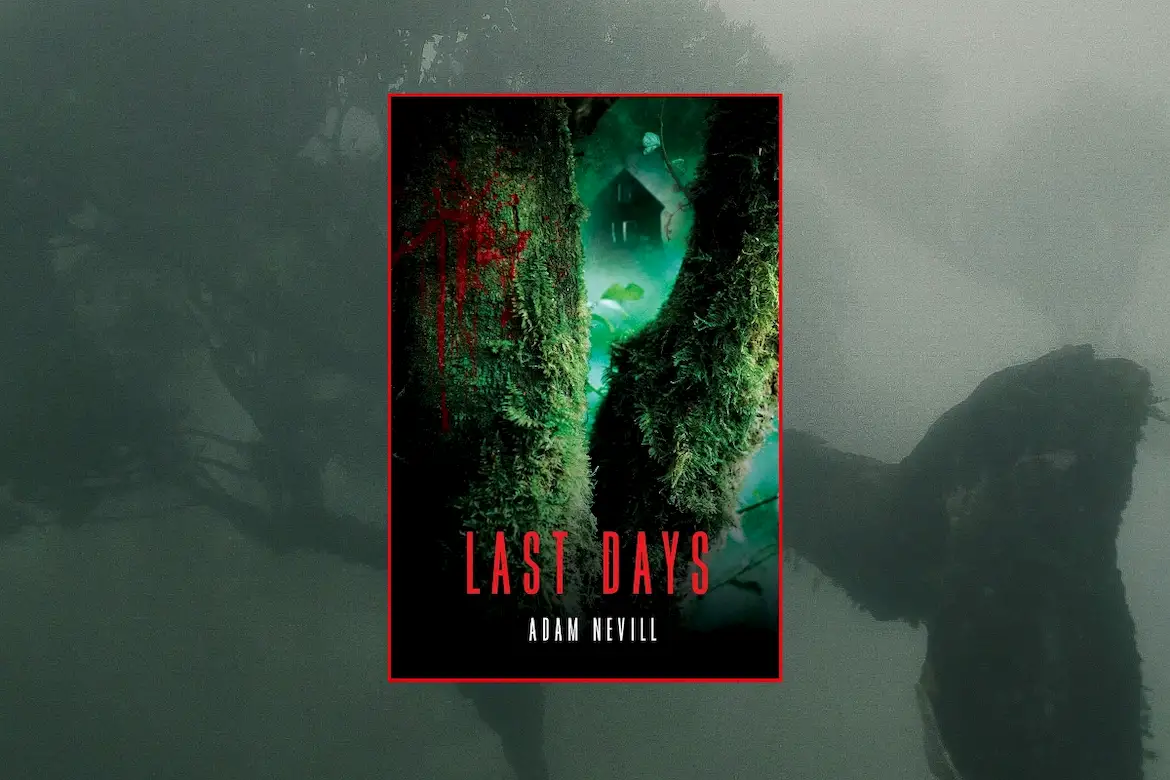
Adam Nevill’s Last Days, is full of atmospheric dread that channels found-footage cinematic terror into a chilling cult novel. It scared the hell out of me, left me feeling paranoid and helpless as in a nightmare, and that’s why this wholly original horror novel is this week’s LitStack Rec.
As an affiliate of Bookshop.org, Malaprop’s, Books-A-Million, Audiobooks.com, Chirp, 2nd & Charles, Amazon, NameHero, Envato, and Place-It, LitStack may earn a commission—at no cost to you—when you purchase through our affiliate links. We appreciate the brands we work with, and also appreciate that using our affiliate links may help you find your next great read, a book or two or more, in whatever form, while simultaneously supporting LitStack. When you use our affiliate links, you help keep LitStack running—and for that, we thank you.
You can find and buy the books we recommend at the LitStack Bookshop on our list of LitStack Recs.

In This LitStack Review of Last Days

Last Days
by Adam Nevill
Pre-Production: The Solomon Commission
Adam Nevill’s Last Days is a slow-burn supernatural horror novel structured as an investigative docu-horror that follows an impoverished independent documentary filmmaker named Kyle Freeman. Facing financial ruin and eviction, Kyle accepts a high-paying, non-negotiable contract from Max Solomon, a wealthy and enigmatic patron dying of cancer. The assignment requires Kyle and his pragmatic freelance cameraman, Dan Connor, to shoot an exhaustive documentary uncovering the truth behind the Temple of the Last Days, an apocalyptic sect that met a catastrophic, blood-soaked end in 1975. Led by the charismatic and tyrannical Sister Katherine, the cult devolved from a countercultural collective into a depraved, ritualistic hellscape before its followers were massacred in an abandoned Arizona mining compound.
Mapping the Blocking of Descent
Nevill treats the setting not merely as a passive backdrop, but as an active, hostile participant. In a book where the main character is not beset by immediate action, the setting and place of this novel needs to do double and triple duty. The various settings (and the settings throughout the novel) function as a character, but also reveal the main character’s paranoia and fears, and also grab the reader, keeping them surrounded by the rising horror. The “villains” in this novel actually emerge from the setting, and quite frankly Nevill’s use of setting and place provides a sensory feast. By anchoring the documentary interviews directly inside the spaces where atrocities took place, and inside the deteriorating homes of survivors, the narrative creates a suffocating and explicitly foreign-feeling liminal environment where past nightmares spill into the present. The cross-continental documentary shoot retraces the cult’s geographic migration across three primary hubs.
Reel One: The Rot Behind Clarendon Road
The journey begins in an eerie, four-story Victorian townhouse on Clarendon Road in London, where Sister Katherine first gathered her inner circle. The setting highlights the contrast between civilized, bourgeois urban architecture and latent rot. Surrounded by peeling wallpaper, pervasive dampness, and unnatural drafts, Kyle and Dan interview Susan White, an eccentric survivor once known as Sister Isis. Nevill uses the verticality and hollow acoustic space of the townhouse to generate auditory dread. As the cameras roll, the house responds with phantom footfalls from vacant upper floors and low sub-bass vibrations that bleed into the audio feeds, establishing that Katherine’s earliest rituals permanently warped the domestic space into a monument of lingering trauma.
In one harrowing sequence early in the book, Kyle watches the day’s footage after he had to run from the house because of phantom wind and noises. It is likely one of the most frightening sequences I’ve read in a horror novel. The use of found footage as narrative is ingeniously laid out and it feels so incredibly real and harrowing that it will give you nightmares. And this is only the horror he sees on film; later in the book, the horrors manifest in real time. Even then, the scenes take place in Kyle’s limited perspective and so the feeling of found footage persists. We are surrounded, as Kyle is, by terrors that lurk in the dark, something rushing past us, something brushing your sleeve, someone touching your face; are those fingers, something dead, something unspeakable, now grabbing you around your neck?
Reel Two: The Normandy Exclosure
The documentary production then crosses the English Channel to an isolated agricultural compound outside Mortain in Normandy, marking the phase where the cult escalated into ritual starvation, psychological abuse, and blood rites. This environment trades urban claustrophobia for damp, feral decay, defined by dense woodland, encroaching mud, and rusted barbed wire originally strung to prevent followers from fleeing, and bear traps. During interviews with surviving figures like Jean-Louis, the surroundings amplify an atmosphere of raw paranoia. Dilapidated stone outbuildings still bear the physical scars of the past, from humanoid grease stains embedded in the plaster to deep gouges carved into the walls. By plunging the filmmakers into rotting barns where their camera-mounted lights fail to reach the far corners, the farm becomes an open, festering tomb where the physical traces of Katherine’s summoned entities are undeniable.
Reel Three: Sunlight Without Sanctuary
The final leg of the documentary shifts to the sun-bleached ruin of the Blue Oak Mine in the Arizona desert, where the cult met its apocalyptic end. Rather than relying on traditional shadows, Nevill exploits the blinding, aggressive heat of the Sonoran waste to subvert standard horror expectations and prove that daylight offers no protection. Kyle conducts inquiries with local historians and explores the massacre site among scorched corrugated-tin barracks and yawning subterranean mine shafts. The extreme desolation makes escape impossible, while the metallic groans of cooling tin, sudden dust storms, and heat-induced delirium depict a desert changed into a hostile, inescapable soundstage for the cult’s final horrors.
Between Takes: No Off-Camera Refuge
Even the transient spaces connecting these primary locations, the anonymous, budget roadside motels in London, France, and border towns like Yuma, are not safe havens. In these generic rooms, the dread bleeds out of the historical ruins and into the filmmakers’ immediate reality. The stench of copper and rotting meat seeps through vibrating air-conditioning vents, shadows pool beneath thin beds, and erratic knocking rattles exterior doors in the dead of night, reinforcing that Kyle and Dan are being actively pursued.
The Viewfinder as Armor and Trap
Nevill captures the distinct terror of the found-footage film genre without relying on epistolary gimmicks, embedding cinematic mechanisms directly into his prose. The viewfinder becomes both a shield and an obsession for Kyle and Dan, capturing the morbid instinct to keep recording (and viewing) even when primal survival instincts scream to run. The narrative draws heavily on low-light shooting aesthetics, describing eerie, washed-out tones of infrared night vision, the claustrophobic beam of camera torches, and the disorientation of rapid focus hunting in pitch-black corridors. Some of the most unnerving set pieces occur during post-production review, as Kyle obsessively scrubs through high-definition footage frame by frame on his laptop, watching shadowy, skeletal contours materialize where the naked eye saw only empty space.
The Final Cut: Dropping the Lens
As the surviving witnesses die violently shortly after appearing on camera, Kyle realizes the cult’s beliefs were not delusions: Katherine had successfully summoned the Old Friends, ancient, emaciated necrotic apparitions that hunt anyone prying into the Temple’s secrets. By the time the crew reaches the Arizona desert, the investigative pacing gives way to raw survival. Kyle uncovers the sinister motives behind Max Solomon’s commission, realizing the film has engineered a final offering to complete the occult circle Sister Katherine began decades earlier. Cut off from help and hunted by both human zealots and the towering, rot-scented entities, Kyle is forced to abandon the camera lens, confront the supernatural fallout of the cult’s legacy, and fight for his life.
Post-Production: Why It Made the Stack
Adam Nevill’s Last Days stands out because it treats fear not as a sudden jolt, but as a creeping, sensory contagion that emerges from place and setting and sensory details. By grounding the narrative in the grimy logistics of indie filmmaking and the journalistic language of real-world psychology of notorious twentieth-century cults (I’m thinking Helter Skelter by Vincent Bugliosi), Nevill establishes an authenticity that makes the eventual supernatural descent all the more disturbing. The novel transposes the immediacy and paranoia of found-footage cinema into straightforward prose. A blinking dead battery indicator, a muffled audio shuffle, an empty doorway, a brush of something against your face, these provoke far more dread than gore.
For readers who crave horror that lingers, this book delivers sustained tension and oppressive world-building. From the rain-slicked decay of European communes to the sun-bleached terror of the Sonoran desert, Nevill crafts a novel of keen and growing paranoia. Every location feels cursed, and every revelation demands a higher price, insisting you participate in what rational minds classify as madness, sheer terror, real horror. By novel’s end, you will believe that unexplainable terrors and horrors lurk in dark places; unexplainable, yes, but you are forced to admit they exist. Last Days is a nerve-shredding novel for anyone who loves investigative true crime narratives, mysteries, cult lore, and stories that force you to look into the dark corners and outer reaches of the frame for the monsters you hope don’t exist, even though they do.
~ J. S. Hood
About Adam Nevill
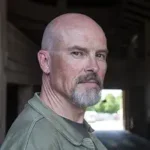
Adam Nevill is a four-time British Fantasy Award-winning author widely regarded as a modern titan of supernatural horror and folk dread. Born in Birmingham, England, and raised between England and New Zealand, Nevill worked for years in editorial publishing before establishing himself as a singular voice of atmospheric, unrelenting terror.
He achieved international breakthrough acclaim with The Ritual, which won the August Derleth Award for Best Horror Novel and was adapted into a hit Netflix feature film. Nevill cemented his reputation as a master of psychological dread with Last Days (2012), an August Derleth Award winner that chronicles an independent documentary filmmaker’s descent into the chilling aftermath of a sinister worldwide doomsday cult.
Known for suffocating atmosphere, uncanny imagery, and visceral body horror, Nevill operates his own independent imprint, Ritual Limited, continuing to push the boundaries of contemporary dark fiction.
You can connect with Adam Nevill on his website, Instagram, Facebook, and Threads.
Publisher: St. Martin’s Griffin
Pub Date February 26, 2013
ISBN Softcover 9781250018182
LitStack Spots Titles by Adam Nevill
Here are a few other LitStack Spots of titles by Adam Nevill that you should buy for your TBR stack, including The Ritual by Adam Nevill, Under a Watchful Eye by Adam Nevill, and The Reddening by Adam Nevill.
Other LitStack Resources
LitStack Spotlights
Be sure and check out LitStack Spotlights that shine a light on books we think you should read. We feature two books each week in our LitStack Spotlight, and offer suggestions for similar titles in our LitStack Spots.
LitStack Reviews
Also look at our LitStack Reviews, including reviews by Lewis Buzbee, Lauren Alwan, Allie Coker, Rylie Fong, and Sharon Browning.
LitStack Recs
Each week we offer a LitStack Rec, sometimes two books at once, sometimes more. Be sure and look at our LitStack Recs where you’ll find what you should read next.
You can find and buy the books we recommend at the LitStack Bookshop on our list of LitStack Recs.


As an affiliate of Bookshop.org, Malaprop’s, Books-A-Million, Audiobooks.com, Chirp, 2nd & Charles, Amazon, NameHero, Envato, and Place-It, LitStack may earn a commission—at no cost to you—when you purchase through our affiliate links. We appreciate the brands we work with, and also appreciate that using our affiliate links may help you find your next great read, a book or two or more, in whatever form, while simultaneously supporting LitStack. When you use our affiliate links, you help keep LitStack running—and for that, we thank you.
As a Bookshop, Malaprop’s, BAM, Barnes & Noble, Audiobooks.com, Amazon, and Envato affiliate, LitStack may earn a commission at no cost to you when you purchase products through our affiliate links.