
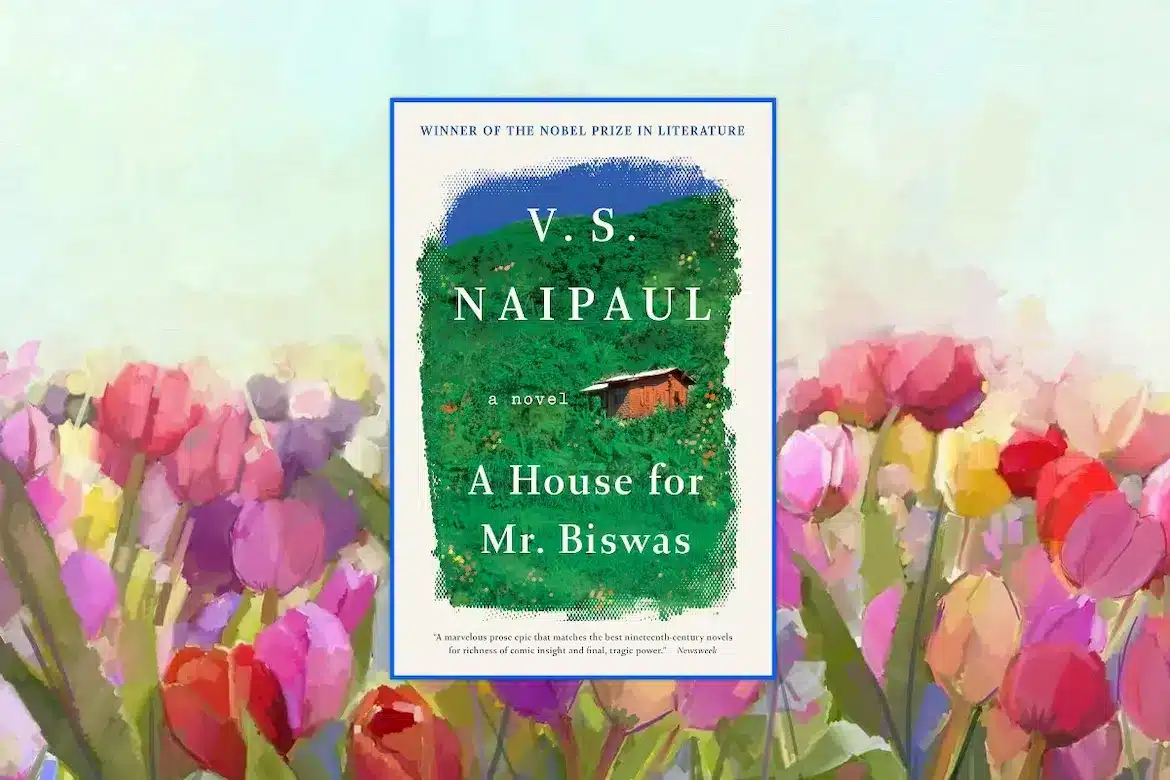
For this week’s LitStack Rec, we urge you to read V.S. Naipaul’s A House for Mr. Biswas, a classic of post-colonial literature.
~Rebecca Yarros
~ Cicero
~ Mary Schmich
You can find and buy the books we recommend on Bookshop on our list of LitStack Recs.

This Week’s Author Shoutouts

Branded Unlucky at Birth
A House for Mr Biswas is one of V.S. Naipaul’s most popular and accessible novels. The story follows Mohun Biswas from childhood through his difficult marriage, serial vocations, and premature death amid mortgage debt. From his birth Biswas is branded as unlucky, and his every move seems ill-chosen. As a young man, having failed in his formal training as a pundit, he leaves the village of Pagotes to make his way in the city of Arwacas, where he falls haphazardly into work as a sign painter, then marriage to a girl from a prominent merchant family, the Tulsis.
In this passage from A House for Mr Biswas, the young Biswas waits in the sitting room of his future in-laws, summoned after a note he impulsively wrote to one of the daughters was intercepted. The matriarch, Mrs. Tulsi, is intent on marrying off the daughter in question, Shama, and as Biswas waits, he observes the unfamiliar room:
The most important piece of furniture in the hall was a long unvarnished pitchpine table, hard grained and chipped. A hammock made from sugar sacks hung across one corner of the room. An old sewing machine, a baby-chair and a black-biscuit drum occupied another corner. Scattered about were a number of unrelated chairs, stools and benches, one of which, low and carved with rough ornamentation from a solid block of cyp wood, still had the saffron colour which told that it had been used at a wedding ceremony. More elegant pieces—a dresser, a desk, a piano so buried among papers and baskets and other things that it was unlikely it was ever used—choked the staircase landing. On the other side of the hall there was a loft of curious construction. It was as if an enormous drawer had been pulled out of the top of the wall; the vacated space, dark and dusty, was crammed with all sort of articles Mr Biswas couldn’t distinguish.
Biswas is an outsider, seeing the world in fine detail—in the wonderful term “pitchpine,” the “hammock made from sugar sacks,” the “black-biscuit drum,” and the carved wedding bench.

Portrayals With An Insider’s Eye
At the time of writing the novel A House for Mr Biswas, Naipaul’s native Trinidad and its colonial and migrant Indian societies was unwritten as European literary settings. Yet Naipaul’s approach to detail portrays his milieu in vivid fashion, plunging the reader into its world, and portraying the upcountry villages, and Port of Spain streets, offices, markets, and households with an insider’s eye.
A solicitor’s office is “a tiny wooden shed standing lopsided on eight unfashioned logs. The distemper on its walls had turned to dust.” An undertaker’s shop is “a plain, corrugated iron shed that made no concession to grief, smelling of new wood, fish-glue and french polish.” Naipaul’s settings have an immediacy that explains nothing—and says everything, and is as much a vivid character as the members of the Biswas and Tulsi families.
At Ground Level
Naipaul began his career in the late 1950s as an Oxford graduate who edited “Caribbean Voices” for BBC Radio. His literary career spanned decades, in works of fiction and nonfiction, as well as appearances in the news for personal rants, literary feuds, and charges of misogyny and abuse. But if the man was flawed, his writing was brilliant—from his chronicles of life in Trinidad and Tobago, to his political critiques of post-colonialism and travel writings, to his stories and essays. At the heart of his work was, as he described in his 2001 Nobel speech, the experience of being “between two worlds.” In the Nobel speech, he addressed those early struggles to portray his native Port of Spain, Trinidad, a place largely unknown to the European audience he sought:
…one day there came to me the idea of starting with the Port of Spain street to which we had moved from Chaguanas. . .This street life was what I began to write about. I wished to write fast, to avoid too much self-questioning, and so I simplified. I suppressed the child-narrator’s background. I ignored the racial and social complexities of the street. I explained nothing. I stayed at ground level, so to speak.
Naipaul sought to avoid explanations of context and scene setting. Instead, he used the ground level approach to present detail as if from one insider to another. The term “ground level” is intentionally intimate, local and specific, and as Naipaul says, ignores the complexities and explains nothing.
A House for Mr Biswas is a classic of post-colonial literature. If you haven’t yet read Naipaul’s work, A House for Mr Biswas is a great place to start.
—Lauren Alwan
About V.S. Naipaul

Sir Vidiadhar Surajprasad Naipaul (1932–2018) was a Nobel Prize-winning writer renowned for his insightful and often controversial explorations of colonialism, cultural displacement, and the post-colonial world. Born in Trinidad to a family of Indian descent, he left for England at age 18 on a scholarship to Oxford, settling there permanently.
His early, comedic novels, such as A House for Mr Biswas (1961), drew on his Trinidadian experiences. He later shifted to darker, travel-based narratives and non-fiction, including An Area of Darkness and A Bend in the River. Naipaul’s work, characterized by its elegant prose and unflinching critique of developing nations, earned him the Nobel Prize in Literature in 2001.
V.S. Naipaul died peacefully at his home in London on August 11, 2018, at the age of 85. While his family did not specify a direct medical cause of death, his wife, Lady Nadira Naipaul, stated that he “died surrounded by those he loved, having lived a life which was full of wonderful creativity and endeavour.” It was widely known that he had been in poor health leading up to his death.
Other Titles by V.S. Naipaul
Other LitStack Resources
Be sure and look at our other LitStack Recs for our recommendations on books you should read.
Be sure to look at other Author Shoutouts, a weekly feature on LitStack, and be sure and support independent bookstores – buy a book today at LitStack Bookshop, with tons of author titles.
Also take a look at our LitStack Reviews, including reviews by Lewis Buzbee, Lauren Alwan, Allie Coker, Rylie Fong, and Sharon Browning.
Support Independent Bookstores.
You can find our Author Shoutouts on bookshop.org at LitStack Author Shoutouts.



As a Bookshop, Malaprop’s, BAM, Barnes & Noble, Audiobooks.com, Amazon, and Envato affiliate, LitStack may earn a commission at no cost to you when you purchase products through our affiliate links.