
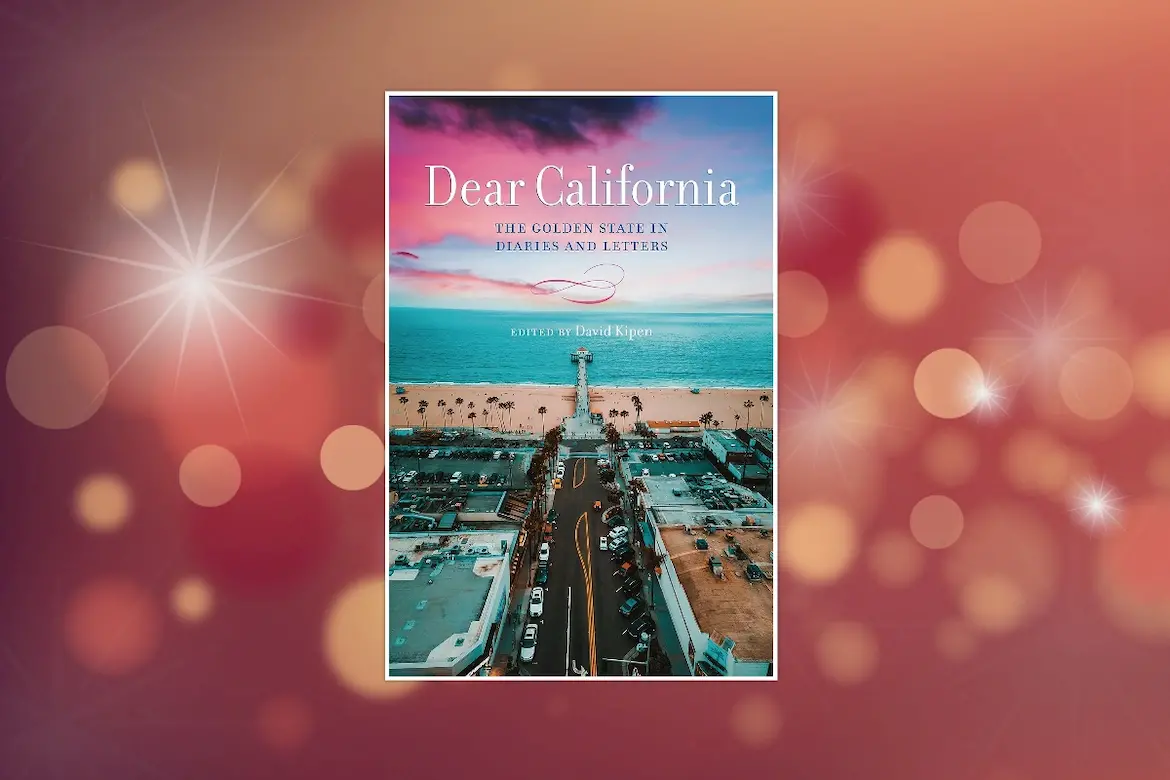

In This LitStack Review of Dear California
Other People’s Mail
Reading letters and diaries, we encounter voices that are more intimate and private than in those texts intended to be published. Even if the letter writer or diarist—a politician, a celeb, a poet—imagines, with vanity, that these documents might one day be published for posterity, the forms of address demand unguarded responses.
With a letter, the addressee is paramount: Dear You. Whether begging for money, sending news from afar, declaring love or protesting the lack of it, there is an implied conversation between two parties. There’s also a conversation implicit in diaries, between the writer and themselves, between the writer and the world: observations, arguments, questions.
When we’re allowed to eavesdrop on these private conversations—as we are in Dear California, lucky us!—we’re able to see beyond the public persona to the stories we truly crave: It’s more complicated than it seems.
Complex California
Under David Kipen’s thorough and witty editing, Dear California: The Golden State in Diaries and Letters, offers a beguiling portrait of a place whose mythologies often overshadow the truth of life on the west coast. The California presented here is neither El Dorado nor Communist Hellscape; rather, we find a place of hope and despair, luxury and poverty, freedom and menace, beauty and, yes, ugliness. Dear California reveals the complexity of this world through dispatches from the front lines.
The complexity of the portrait comes from its mass; Dear California includes letters and diaries from over 500 contributors, ranging in time from the early sixteenth century, when California was an as yet unexplored Spanish fever dream to the present day and the effects of the COVID lockdowns.
In Dear California, many of the correspondents and diarists are, naturally, writers—writers do like to write—and many we easily connect to California: Steinbeck, London, Stevenson, Melville, Twain. But many other writers surprised me: Henry James, Laura Ingalls Wilder, Rudyard Kipling, E.M. Forster. And because of the Hollywood boom in the first half of the twentieth century, there are many writers who notoriously came for the scriptwriting money: Fitzgerald and Faulkner, of course, but also Christopher Isherwood, Nathanael West, Aldous Huxley.
History’s Storms
Kipen, however, includes many non-writers in Dear California, as it should be. Louise Clappe, “a proper English lady” and Gold Rush participant. Nikki Lastreto, “a San Francisco teenager.” Helen Wild, 1906 earthquake survivor. Jose Miguel Venegas, who went out to buy tortillas one day and was struck by a car and dragged ten blocks. Aoki Hisa, WWII internee. Soldiers from Spain, Mexico, the U.S. Politicians, activists, actors and directors, business and tech moguls, citizens of all stripes and classes and leanings. As diverse a selection as California’s population, then and now. This is not history, but history as seen by those who lived through its storms.
Whether the writers are famous or otherwise, the excerpts range from the profound to the banal, and there’s some wonderful method to this madness. Yes, the book insists, history consumes us, but we must also live the day before us. We see life in all its lights.
Burros and Earthquakes
Here are a few entries from Dear California, randomly selected.
“Continues fine freezing hard at night this a beautiful morning…virginas toes frozen a little snow settleing.”—1847, Patrick Breen, of the Donner Party
“Rode on a burro first time. Liked it”.—1890, Charlotte Perkins Gilman, novelist
“Big earthquake…The tallest bookshelf flew apart, broke a window. Books everywhere. Made my way outside; car alarms wailing, lots of people in the dark streets…”—1994, singer, songwriter Warren Zevon
“My husband and I went to the Alien Registration Office. There were four policemen on guard. It is only a little after opening hour of eight, but there are many people there. There are Germans and Italians, but Japanese make up the majority.”—1942, Aoki Hisa, about to be interned
“…native-to-the-southwest plantas: la salvia. Always my homecoming scent. The soft dryness of mimosa-powdery dust bajo los eucaliptos y pinos…”—2007, Susan Chávez-Silverman
“…God, what I need is a man…”—1968, Octavia Butler, novelist
“I like this place. I think California scenery is the most loathsome on earth,–a cross between Coney Island and the Riviera, but by sticking in one’s garden all the time and shutting one’s eyes when one goes out, it is possible to get by.”—1930, P.G. Wodehouse, novelist
The Last Letter
By far the most troubling notes are those left behind by those who died by suicide. There are some five or six in Dear California, and while reading them does feel invasive, prurient, there’s also the sense—for me, at least—that the note’s writer is no longer alone, that there has been another human to witness their pain, to honor their struggle. We’ve entered a wholly other type of correspondence, between the writer and the world at large and life itself. Reading these notes is eerie, unsettling, but ultimately necessary to complete this spherical portrait of how we live.
“I am afraid I am a coward. I am sorry for everything. If I had done this a long time ago, it would have saved a lot of pain,” wrote the actress Peg Entwistle in 1932, shortly before throwing herself from the Hollywood sign.
Our Dear California, these notes remind us, is not only a state of aspiration, but one where aspiration often fails and some pay the cost of that disillusionment.
Same Day, Different Year
But the big trick—and accomplishment–of Dear California is its unique structure. Rather than ordering these letters and diaries chronologically, which would seem the most reasonable course, Kipen has ordered the book on the days of a single year, starting with January 1st and ending on December 31st. So that, for example, on January 1st, we find entries from 1795, 1847, 1848, 1906, 1944, 1969. The main effect is this, that all these people, living centuries apart at times, share this same place and this same life. The order creates a sphere rather than a line.
And by juxtaposing these disparate years, the histories and myths of California are revealed little by little. Over the course of the book, we put these stories together, though not necessarily in order: the earliest European explorers, the U.S. genocide of indigenous tribes, the Chinese Exclusion acts, Silicon Valley, the scourge of AIDS, the Gold Rush, the 1906 earthquake, Japanese internment, the war between Mexico and the U.S., the rise of Hollywood, the Beats, the evolution of Yosemite as a National Park, drought and fire. And so much more.
In the end, and by its nature, Dear California is woefully incomplete: How could it possibly contain every story, every person? It can’t. But this is no detriment to the reader, for in its complete incompleteness, the book asks the reader to continue to fill out the capacious sphere of this state, to consider and add stories of their own, of the people around them, of the histories and myths not yet recorded. We are all in this together, now and then.
Where’s Joan?
As I read deep into Dear California, I kept asking, where’s Joan Didion? There were references to Didion, of course, some acquaintances of hers, and even an entry from her husband, John Gregory Dunne. But where was Joan? Surely this was no oversight. Could it be a rights issue, permission not granted?
Then, on the last page of the book, the final entry, there she is, a note written on the one-year anniversary of her husband’s death. “The craziness is receding, but no clarity is taking its place. I look for resolution and find none.” Only fitting that she have the last word.
~ Lewis Buzbee
About David Kipen, Editor of Dear California
David Kipen was born and raised in Los Angeles. California native David Kipen has worked as the San Francisco Chronicle’s book editor/critic, Director of Literature at the NEA, and, lately, L.A. Times critic at large and founder-director of the Libros Schmibros Lending Library. Previous books include Dear Los Angeles and four reissued WPA Guides. His California-set historical paranoid conspiracy thriller, The Anniversarist, is forthcoming. Really.
You can learn more about David Kipen on wikipedia, or connect with him on Facebook or LinkedIn.
Dear California: The Golden State in Diaries and Letters
ed. David Kipen
Redwood Press, 2023
ISBN Paperback: 9781503643581
Titles by David Kipen and Others
Other LitStack Resources
Be sure and look at our other LitStack Reviews for our recommendations on books you should read, including reviews by Lewis Buzbee, Lauren Alwan, Allie Coker, Rylie Fong, and Sharon Browning.
Author
Other Reviews by Lewis Buzbee
Comment Using Emote

As a Bookshop, Malaprop’s, BAM, Barnes & Noble, Audiobooks.com, Amazon, and Envato affiliate, LitStack may earn a commission at no cost to you when you purchase products through our affiliate links.