Food and Time, two wonderful things to contemplate. Here is a double LitStack Rec of Jerusalem A Cookbook, and All Our Wrong Todays. Enjoy!
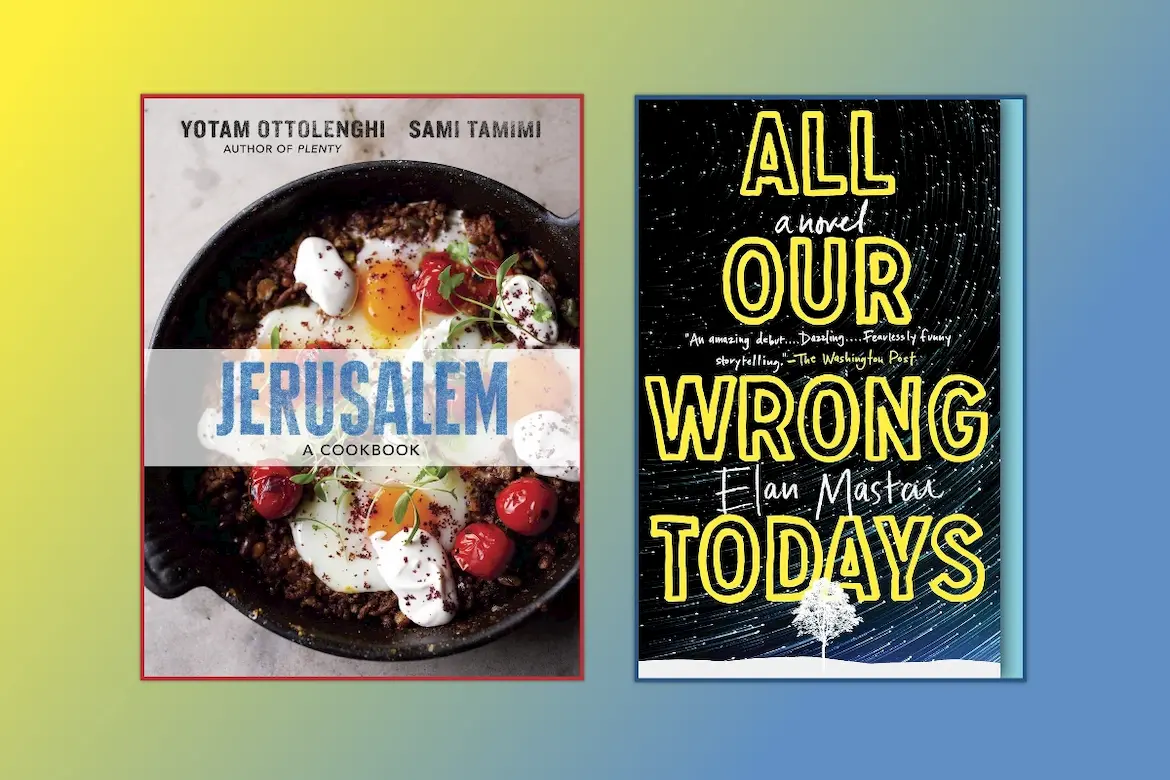
In this LitStack Rec of Jerusalem and All Our Wrong Todays
Jerusalem – A Cookbook
by Yotam Ottolenghi and Sami Tamimi.

Some cookbooks are defined by a generation. Your grandmother’s shelf likely held The Joy of Cooking or Julia Child’s The French Chef. Your mother’s, The Silver Palate or The Moosewood Cookbook. Jerusalem is a cookbook that has similarly struck a culinary-cultural nerve, tapping into an unbridled interest in global and cross-cultural cuisine. Even if the book isn’t on your shelf, you may well have been served one of its delectable dishes at a dinner party. The large format, full-color 320-page volume (published in 2012 by Ten Speed Press), has a unique across-the-board appeal—how many cookbooks can claim to be listed in the Anthropologie catalog?
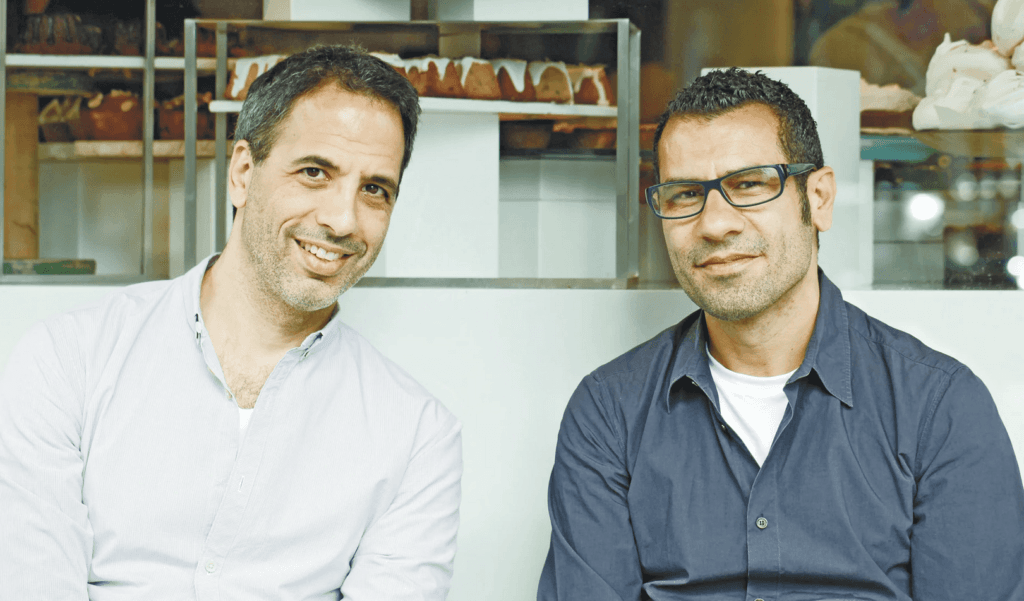
The book’s authors grew up on opposite sides of the divided city, and now both live in London—Tamimi in the Arab East, Ottolenghi in the Jewish West. The 120 collected recipes, whose categories range from soups and condiments to meat, fish, and an intriguing category called “Stuffed,” tap into iconic flavors and ingredients of the Near East—lemon, lamb, chickpeas, and eggplant, for example—ingredients whose origins may be humble, but which here take on a Michelin five-star appeal. The book’s design is glorious, not to mention practical (the oversize format has a waterproof cover and lies flat easily). The photographs are full-page, some two pages, and the color and detail are gallery-worthy. In a starred review, Booklist said, “the passion and skill evident in this collection of Mediterranean cuisine are contagious.”
Jerusalem (the city) is historically known for its wide-ranging influences—Christian, Muslim, and Jewish cuisines—that incorporate flavors from across cultures: Iran, Poland, Syria, Italy. Of the book’s intense appeal, The New York Times said:
“Jerusalem seems like an open door to a new realm of flavor. The recipes are full of sun, accented with salt, and rife with crunchy and creamy contrasts. There are new grains, greens, and spices to explore, and fistfuls of garlic, capers, feta cheese, and other familiar ingredients from around the Mediterranean.”
Some cooks may be put off by lists of ingredients, but for the recipes in Jerusalem, it’s likely most are already in your pantry. My first attempt was the “Roasted cauliflower and hazelnut salad,” a gem whose most exotic ingredient was pomegranate seeds—and the sherry vinegar I had to buy. If you think cauliflower doesn’t belong in a salad, you have yet to eat it roasted, a preparation common in Near East cooking. I first ate roasted cauliflower in my Turkish grandmother’s kitchen and can attest to the superior sweet nuttiness achieved by roasting. The addition of toasted hazelnuts, celery, parsley, and spices bring the bright flavors and lively textures typical of Ottolenghi and Tamimi.
As the Times noted, Jerusalem may well be the only cookbook with its own social media hot zone: #tastingjrslm is certified across a number of sites. Though for me, preparing the dishes in this extraordinary book is far more pleasurable than sharing them online.
—Lauren Alwan
All Our Wrong Todays
by Elan Mastai
Most of us have read stories about future dystopias, for a while they were a dime a dozen. But Elan Mastai’s takes this premise and gives it a unique spin: what if the life we now know, the life of 3D printers, cell phones, microwaves, the internet – what if we are the dystopia, a pale shade of what might have been?
An Alternative, Boundless Earth
In Tom Barren’s 2016, things are pretty swell, despite his being the lackluster son of a genius father. There are moving sidewalks and flying cars, instantaneously produced clothing that is recycled daily, food packs full of nutrients and flavor, neural communications and entertainments. The air is clean, the water is pure, the world is (more or less) at peace and virtually everyone is content. The theory of time travel (of which Tom’s father is the world’s authority) is nearing experimentation. All this largess is primarily due to the implementation, on July 11, 1965, of the Goettreider Engine, an amazing device that harnesses the constant rotation of the Earth to generate “boundless, robust and absolutely clean energy.”
But when the first foray into actual time travel goes tragically awry, the past is altered and Tom finds himself in a far different reality—our reality. Not only is the world vastly different, from the oily-smelling air to the horror of petroleum-powered vehicles and combustion engines and clothing actually made from plant and animal fiber (to name just a few) but his family dynamic is also drastically changed. And it’s all Tom’s fault. Now the question is—can he fix it? Or perhaps the better question is—should he?
That’s a very intriguing question, the answer of which is not really clear—which is part of the draw of this book.
Full disclosure, I admit that initially I was put off by the literary styling of All Our Wrong Todays: extremely short chapters written in a very disjointed voice that seemed to ricochet from apologizing to extemporizing and back to apologizing again. Even knowing that the narrative was the journaling of a confused, mundane loser couldn’t keep me from feeling jerked around by choppy prose that seemed to set up constant mini-cliffhangers at the end of each micro-chapter.
But the further I got into the story, the more appropriate that styling became and the more it seemed to bolster the character of Tom rather than distract from the narrative. And by the time the story progressed to discussions of time travel and alternate realities and humanist conundrums, I needed to be fed in small, simple doses.
A World Too Good to Be True?
One of the main tenets of the novel comes from real-life cultural theorist Paul Virilio—the idea that every time you introduce a new technology, you also introduce the accident of that technology, so while you can anticipate the good it will do you must also figure out just how badly it can screw things up. This adds an interesting philosophical angle to the narrative without getting bogged down into theoretical and technological minutia. In fact, All Our Wrong Todays throws in a number of diverse and yet recognizable layers that end up actually enhancing the story rather than distracting from it.
While indeed, the world that Tom originates from is a bit too good to be true, the dilemmas he faces are not diminished by it—and after all, he’s speaking from his own experience and his own understanding which is, as he himself freely admits, somewhat naive. Still, All Our Wrong Todays adds to my belief that time travel, while imaginative, is best left the heck alone. Thankfully, the novel goes about bolstering that belief in a fun and entertaining way.
~ Sharon Browning
Other LitStack Resources
LitStack Spotlights
Be sure and check out LitStack Spotlights that shine a light on books we think you should read. We feature two books each week in our LitStack Spotlight, and offer suggestions for similar titles in our LitStack Spots.
LitStack Reviews
Also look at our LitStack Reviews, including reviews by Lewis Buzbee, Lauren Alwan, Allie Coker, Rylie Fong, and Sharon Browning.
LitStack Recs
Each week we offer a LitStack Rec, sometimes two books at once, sometimes more. Be sure and look at our LitStack Recs where you’ll find what you should read next.
You can find and buy the books we recommend at the LitStack Bookshop on our list of LitStack Recs.


As a Bookshop, Malaprop’s, BAM, Barnes & Noble, Audiobooks.com, Amazon, and Envato affiliate, LitStack may earn a commission at no cost to you when you purchase products through our affiliate links.