
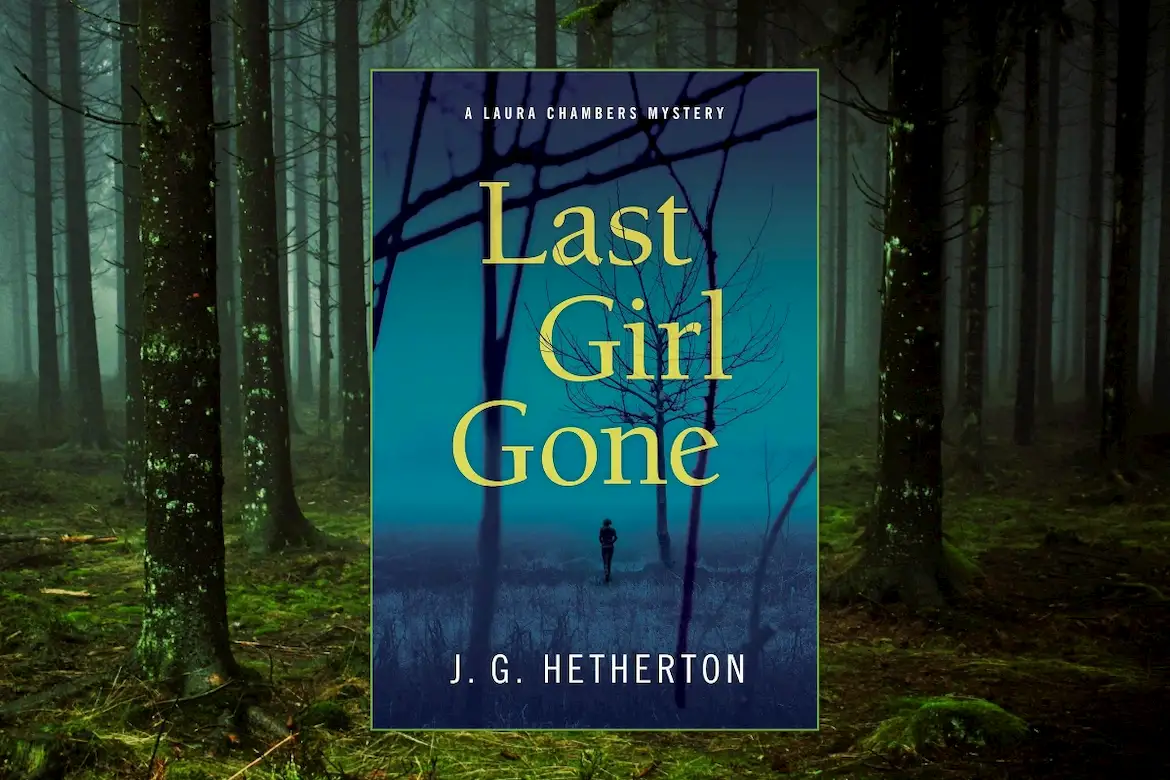
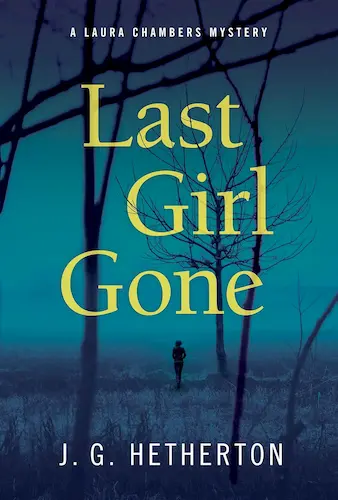
In Last Girl Gone, investigative journalist Laura Chambers returns to her hometown after a career setback only to find herself investigating a missing girl case.
Be sure and catch the author interview at the end of this review!
As an affiliate of Bookshop.org, Malaprop’s, Books-A-Million, Audiobooks.com, Chirp, 2nd & Charles, Amazon, NameHero, Envato, and Place-It, LitStack may earn a commission—at no cost to you—when you purchase through our affiliate links. We appreciate the brands we work with, and also appreciate that using our affiliate links may help you find your next great read, a book or two or more, in whatever form, while simultaneously supporting LitStack. When you use our affiliate links, you help keep LitStack running—and for that, we thank you.
In This LitStack Review of Last Girl Gone

You can find and buy the books we recommend at the LitStack Bookshop on our list of LitStack Recs.

Last Girl Gone
by J. G. Hetherton

Around the Corner, Ahead of the Curve
As a reader who calls North Carolina home, I’m always curious to read stories spun out of local lore and reference. In Last Girl Gone, J.G. Hetherton electrifies a tiny NC town through a fast-paced, high-risk plot that gives it the tension of a larger metro area. After devouring this novel, I ran to start the second in the series, What Lies Beneath, and would suggest you don’t miss it either.
It’s 1988 and Patty Finch has already tried to run away from home three times. Abandoned by her dad and abused by her mom, Patty tries her best to lose herself in a NASCAR crowd only to end up losing herself possibly forever. After attempt two, Deputy Don Rodgers realizes the girl needs help and tells her that he will try to do so. While kind, his offer may be too little too late.
History Repeats Itself
Just shy of three decades later, another young girl is found dead, and before her murder can be solved, yet another, named Theresa, goes missing. Luckily, disgraced journalist Laura Chambers has just returned from her role with the Boston Globe to the previously sleepy town of Hillsborough, NC where she grew up.
Now twenty-nine years old, some things haven’t changed in the intervening decade that Laura has been away. The mayor’s son, Colin Smythe, for instance, also works on the paper and thinks he rules (or should rule) the entire town. His disdain for women shows through his contentious relationship with Laura. She reports this to her therapist, Dr. Jasmine DeVane, who seems to be the closest thing Laura has to a friend these days.
Colin carries the threat of violence and disregard in his menacing behavior, but Laura seems determined to keep the story out of his hands if she can. Her Hillsborough Gazette job may be less than glamorous, but she is grateful to the Editor in Chief, Bass Herman, for taking a chance on her after being fired from the Globe.
Another aspect that has remain unchanged—the house she grew up in and her mercilessly cruel recluse of a mother who despite her own glaring shortcomings tries to pin her embarrassment on Laura instead.
It Takes a Village
While Laura’s journalism mentor has passed, she reminds herself of the warning he gave against the siren song of the vanity of the byline. We see her struggle with boundaries as she cozies up to Deputy Frank Stuart, partially out of attraction and care, partially because it puts her closer to the story. She herself seems unsure at times whether she is using Frank or not.
With Frank feeding her tips, a student photographer from the high school, and an FBI field officer named Timinski, Laura tries to get to the bottom of the disappearing and murdered girls with some help from retired Sheriff Don Rodgers as well.
Arousing Suspicion
Unsentimental and unflinching, Hetherton’s narrative is visual, detailed, and taut with great restraint between what is said and what is not. He highlights desperation in all its forms and gives his protagonist an unapologetically ambitious nature. Yes, she wants to help the families of the victims, but she also wants to feel the sun shine on her once again. Hetherton has created an intimate portrait of the 7,000 inhabitants, and as the mystery expands, the reader begins to wonder if the whole town is involved on some level. But will the hunter become the hunted? Is Laura herself in danger? Hetherton drops just enough clues organically along the way to hold the reader in thrall until the last page.
~ Allie Coker
Interview with J. G. Hetherton
with Allie Coker
LITSTACK: What is your connection to Hillsborough, NC? What made you decide to set your novel there?
HETHERTON: I lived in Carrboro before Durham, and the Occoneechee Speedway in Hillsborough was only about twenty minutes away and was one of our top dog-walking locations. I must have walked around that loop in silence a hundred times with no thoughts of it as a setting in some book, and one day the whole prologue to Last Girl Gone basically fell into my lap, from…wherever these things come from…and the idea was set right where I was standing.
It took me a few more years to figure out the rest and write it all down. When I was finished, it had some major differences from the book as published, the big ones probably being that it was set in a small town called Westmark, Missouri, and that the timeframe was the 1980s. Both aspects were changed pre-publication for various reasons, but the town I created was a combination of Hillsborough and the small town where I grew up in Wisconsin. Since I’d let the story begin at a real location, a lot of the geography was taken from Hillsborough and the surrounding area. From my own hometown I took a sense of remoteness, of an insular community, of your town being a collection of buildings standing along in the middle of fields as far as the eye can see. Surrounded by so much empty space it might as well be a moat or a wall, keeping at bay the outside world while at the same time trapping the inhabitants inside. Real Hillsborough, as you know, is practically cosmopolitan these days; Durham and Chapel Hill are both less than half an hour away. I’m not too particular about setting specifics, as long as it serves things like tone. And for the tone of the story, Laura needs to feel like she’s on her own, so I made the story-version much more isolated than in real life.
But in the book, it’s both Hillsborough and not at the same time. Laura is washed up in the small hometown she’s always hated, but none of that is Hillsborough’s fault. The real Hillsborough is a perfectly nice town, and I was a bit nervous how the book would be received by residents (or the city council, or the chamber of commerce. etc.) But I hoped they would understand that what I did, I did in the service of the story. I took lovely little Hillsborough and I twisted it. I perverted it, to make it the kind of suspenseful, sinister setting that infuses a good mystery. But also, the town is the way it is because we’re seeing it through Laura’s eyes. Hillsborough is the place where she grew up, and she did not have a very nice childhood. But of course, bad childhoods make the most interesting adults.
LITSTACK: How did you decide that Laura would be a disgraced journalist? What do you feel it adds to her backstory?
HETHERTON: Let me take that in two parts. The disgraced part was easy. I wanted Laura on her backfoot, at a low point in her life, both to give the arc of her character some heft, but also because I wanted her to be in a position where she would be willing to bend the rules a bit, or take risks she wouldn’t normally take, to drive the story forward. Laura’s profession is everything to her. This is a person who’s spent their life feeling less-than, she wants to feel more-than, and the tool she’s going to use to fix it is her work. If the work is good enough, she’ll finally be good enough. I also think she’s reflective enough to recognize some of the psychological forces at play inside her head, and one of the main tensions of her character is ambivalence about her own ambition.
The job of an investigative reporter is to counterbalance powerful people and institutions, to take the side of the downtrodden, to empathize with them. It makes them a natural fit as a mystery’s protagonist. Laura does all those things, but she also wonders how much of her interest is self-interest—that question is always in the back of her mind. For someone so caught up in their career, I wanted to make her professional life as difficult as possible.
LITSTACK: You have such cruel characters sprinkled throughout Last Girl Gone. In addition to wondering how a friendly guy such as yourself can craft such villainous characters, I’m curious to know why and how you develop them. Did you feel it was important to have more than one? The plot takes lots of twists and turns, but who do you feel is the real antagonist at the heart of the narrative?
HETHERTON: It feels good to be bad! In my (very limited) experience as an actor this is also true, something about playing a villain is freeing. It’s fun. All those morals and rules are pretty heavy to carry around and throwing them off makes one lighter on their toes in a disturbing sort of way.
Of course, I don’t (generally) do those things in real life, but one of the major appeals of a novel to both reader and writer is escapism, to leave this ordinary life behind for a while and take the ride. Another major appeal is the way in which stories, especially genre fiction, are places where the good guys win and the bad guys lose (to varying degrees). The real world isn’t like that at all, of course, so I take comfort when it happens in books. In romance, it’s happily ever after; in a mystery, it needs to be solved, and the responsible parties held to account. As a writer, I think there is a subconscious feeling that it’s okay to let that part of yourself come out, because it will in time be duly punished.
About J. G. Hetherton

J. G. Hetherton was raised in rural Wisconsin, graduated from Northwestern University, and lived in Chicago for the better part of a decade. Along the way to his first novel, he dabbled in many different day jobs before moving to North Carolina for a girl. They live in Durham, North Carolina with their twin daughters, and when he’s not writing, you can find him on the hiking trail or sitting down with a good book.
You can connect with J. G. Hetherton on his website, and on Facebook.
Recommended Titles by J. G. Hetherton and Others
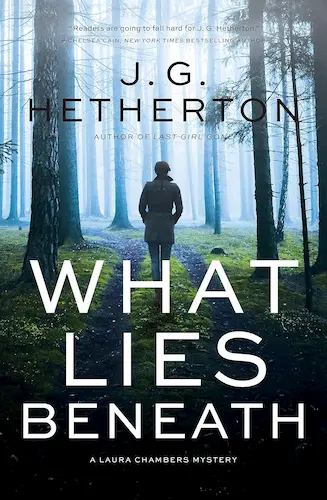
Along with Last Girl Gone, we’re picking up What Lies Beneath by J. G. Hetherton, as well as A Slowly Dying Cause by Elizabeth George and Bath Haus by P. J. Vernon, all titles you’ll definitely want to add to your TBR stack.
Other LitStack Resources
LitStack Spotlights
Be sure and check out LitStack Spotlights that shine a light on books we think you should read. We feature two books each week in our LitStack Spotlight, and offer suggestions for similar titles in our LitStack Spots.
LitStack Reviews
Also look at our LitStack Reviews, including reviews by Lewis Buzbee, Lauren Alwan, Allie Coker, Rylie Fong, and Sharon Browning.
LitStack Recs
Each week we offer a LitStack Rec, sometimes two books at once, sometimes more. Be sure and look at our LitStack Recs where you’ll find what you should read next.
You can find and buy the books we recommend at the LitStack Bookshop on our list of LitStack Recs.
Author
As an affiliate of Bookshop.org, Malaprop’s, Books-A-Million, Audiobooks.com, Chirp, 2nd & Charles, Amazon, NameHero, Envato, and Place-It, LitStack may earn a commission—at no cost to you—when you purchase through our affiliate links. We appreciate the brands we work with, and also appreciate that using our affiliate links may help you find your next great read, a book or two or more, in whatever form, while simultaneously supporting LitStack. When you use our affiliate links, you help keep LitStack running—and for that, we thank you.
As a Bookshop, Malaprop’s, BAM, Barnes & Noble, Audiobooks.com, Amazon, and Envato affiliate, LitStack may earn a commission at no cost to you when you purchase products through our affiliate links.