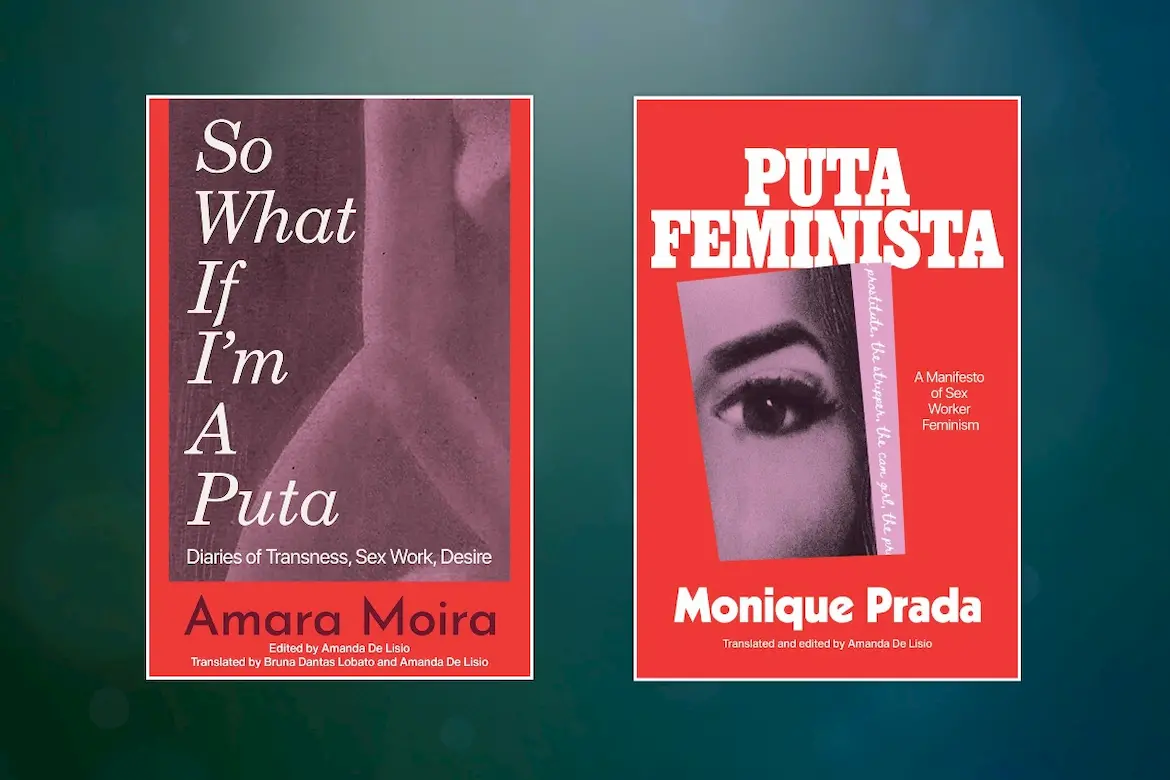
Amara Moira’s So What if I’m a Puta? and Monique Prada’s Putafeminista both offer vulnerable and candid looks into the experiences and struggles of sex workers in Brazil.
You can find and buy the books we recommend at the LitStack Bookshop on our list of LitStack Recs.
As an affiliate of Bookshop.org, Malaprop’s, Books-A-Million, Audiobooks.com, Chirp, 2nd & Charles, Amazon, NameHero, Envato, and Place-It, LitStack may earn a commission—at no cost to you—when you purchase through our affiliate links. We appreciate the brands we work with, and also appreciate that using our affiliate links may help you find your next great read, a book or two or more, in whatever form, while simultaneously supporting LitStack. When you use our affiliate links, you help keep LitStack running—and for that, we thank you.
In This LitStack Review of So What If I’m A Puta and Putafeminista
What stood out to me first about these two texts is their similarities. Not only do both of these works examine the issues sex workers in Brazil face, but they’re also both published by Feminist Press within weeks of each other. Why would a small press choose to publish two works that on the surface appear to offer such similar insights?
In So What if I’m a Puta? Moira offers a deep, detailed, personal narrative that feels as though the pages were lifted straight from her diary, without any editing. Her stream-of-consciousness style runs through the text and makes the reader feel as if Moira is a friend they’ve known for years.
While Moira zooms in, Prada uses Putafeminista to zoom out, giving us a bigger, research-driven view of a similarly driven point. The footnotes are rich with context, citations, and editor’s notes. Prada provides a personal experience in a very different way; instead of showing the inner workings of her mind on the page, she takes the reader’s hand and offers her perspective and understanding through the research and experiences that formed her.
These books are the perfect sister texts; rich pieces of sex worker history that stand strong as their own narratives while also working beautifully together. I strongly advocate for these two works to be consumed together, especially if you’re someone outside of the sex worker community.
Translation
The thing that struck me most about these works is that Amanda De Lisio translates both texts. Her presence as an editor in Putafeminista is immediately felt and, at first, appreciated as a North American reader. On page one, she explains that while the use of the word “prostitute” is contentious in North America, it’s translated form “prostituta” remains to be claimed and defended by sex workers in Brazil.
Prada does make this point on her own about halfway through her essays, and here we see that De Lisio’s footnote mirrors the context given by Prada. Once we arrive at this explanation, it begs the question, why interject with a footnote at the beginning when Prada is sure to give the same explanation earlier on?
It seems to be done to ensure more readers will continue with the essays instead of letting a cultural barrier keep them from reading on. While this might be helpful for a reader who needs this kind of early assurance of cultural differences, this kind of spoonfeeding can make things feel a bit repetitive for an educated reader. Footnotes like this also remove the reader from the translated narrative and serve as a reminder that we aren’t getting essays straight from the source, we’re reading an interpretation of Prada’s words.
In Moira’s diary, De Lisio’s presence isn’t nearly as blatant. We don’t get editor’s notes constantly reminding us who’s telling the story. This allows for a more direct connection to Moira and her ideas. We remember De Lisio’s influence when we see her name on the cover telling us she’s the mediator as the translator and can appreciate her influence without being pulled out of the narrative.
Community
Both authors write about how the internet has changed sex work and the visibility of sex workers. Prada writes about how social media allows sex workers to connect in real time and in this space they can, “claim the space that has always been denied to us as women, as owners of our desires, our destinies, our choices, and which we are fully capable of defending.”
In addition to outright advocating for the importance of community, Prada and Amara show it in how they shape their stories. Prada is referenced in Moira’s So What if I’m a Puta? a few times, including when she refers to Prada and another woman in her community as, “two of the most important putafeministas I have ever met.” The respect Moira has for Prada is beautifully expressed through the way Moira credits women like Prada for their advice and influence in shaping her own philosophy.
In Putafeminista, Prada actually dedicates pages to Moira by having her write one of her forewords. Moira does use some of this space to praise Prada for her influence on the putafeminista movement as well as Prada’s influence on women like her. Prada continues this relationship in her own essays as she references Moira. By having both women’s writing exist in the same narrative, we get to witness how their words and ideas are influenced by each other.
Who Gets to Be a Feminist?
While both authors find comfort in the communities they’ve created and found for themselves, there is also a struggle in finding acceptance. Unfortunately one area neither feels acceptance is in communities that claim to be feminist, but shame sex work and/or sex workers.
In Putafeminista, Prada reminds us that the category of “woman” is vast, consisting of endless intersections. Of course there are going to be diversions in experiences and even in beliefs. She expresses disappointment in the reality of divisions existing that battle each other, a major divide she identifies as “feminist prostitutes and the feminists who position themselves against the idea of prostitution…”.
She goes on to argue that you can’t separate sex work from the sex worker, so if you’re against one you are inherently against the other. Prada draws firm lines and boundaries around what she believes makes someone feminist and a supporter of women’s freedoms. If you are someone trying to remove sex work as a way for women to work, then you’re a conservative feminist fighting for a “dystopian utopia.”
In So What if I’m a Puta? the reader gets to experience the perspective of one of the intersections of identity that Prada identifies, that of a feminist travesti. She talks about how sex work provided a gender validation she hadn’t yet found anywhere else, “…it all made me feel more like myself, more of a woman.” The vulnerability and honesty of this statement hits hard.
Although I wished Amara explored the complexity of achieving gender validation through sex work with problematic men more in her diary, there are plenty of moments where the reader is fully brought into her experiences, regardless of their background, We are hit in moments of betrayal, such as when her friend tells her “I accepted you as a travesti, but I can’t accept you as a puta,” Amara’s vulnerability allows us to experience isolation with her and understand her point that feminists who refuse to speak with and understand sex workers, aren’t feminist at all.
~ Jess Reincke
About Amara Moira
Amara Moira is a writer, academic, and self-described “travesti putafeminista.” She is a columnist at Buzzfeed Brasil and UOL Esporte. Moira received her PhD in literature from Universidade Estadual de Campinas, wrote her dissertation on James Joyce, and became the first trans woman to graduate using her chosen name. She has given two TEDxBrazil talks: “Who’s Afraid of Trans Women?” and “The World of Trans Words.” She is the author of So What If I’m a Puta and the poetry collection Neca+ 20 Poemetos Travesso, and a co-contributor to the collection Vidas Trans: A Coragem de Existir (Trans Lives: The Courage to Exist). She lives in São Paulo, Brazil.
About Monique Prada
Monique Prada is the author of Putafeminista, published in 2018 in Brazil. She is a militant defender of sex worker rights, creating the blog Mundo Invisível (Invisible World) in 2012 and participating in popular debates. She also served as president for the Central Única de Trabalhadoras e Trabalhadores Sexuais (CUTS), member of the UN Women Civil Society Advisory Group, and advocated for Bill 4211/2012 by Federal Deputy Jean Wyllys, which sought to regulate the profession in Brazil. She lives in Porto Alegre, Brazil.
Jess Reincke is a nonfiction writer living in San Francisco, California. She has an MFA in Creative Nonfiction Writing from USFCA. In addition to writing for LitStack, Jess is also a writer for the fashion and art magazine Only The Good Stuff.
Be sure and check out LitStack Spotlights that shine a light on books we think you should read. We feature two books each week in our LitStack Spotlight, and offer suggestions for similar titles in our LitStack Spots.
Each week we offer a LitStack Rec, sometimes two books at once, sometimes more. Be sure and look at our LitStack Recs where you’ll find what you should read next.
You can find and buy the books we recommend at the LitStack Bookshop on our list of LitStack Recs.
As a Bookshop, Malaprop’s, BAM, Barnes & Noble, Audiobooks.com, Amazon, and Envato affiliate, LitStack may earn a commission at no cost to you when you purchase products through our affiliate links.