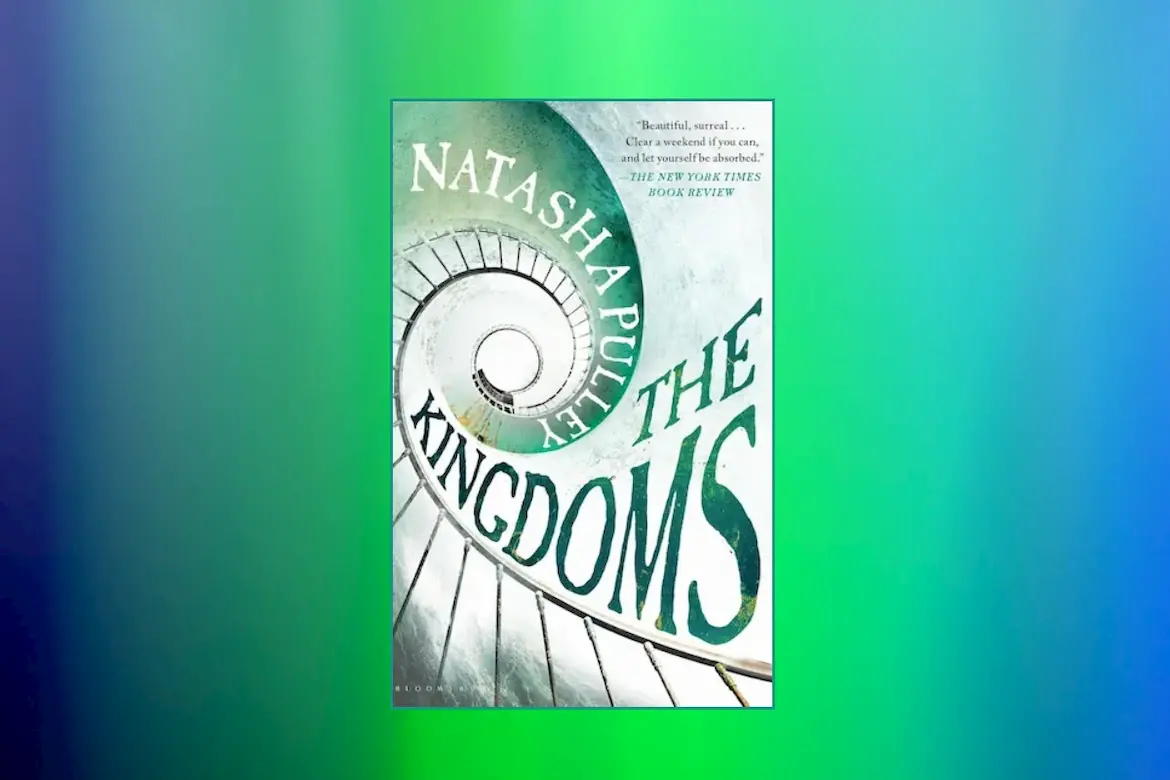
The Kingdoms by Natasha Pulley is a genre bending, time twisting alternative history that asks whether it’s worth changing the past to save the future, even if it costs you everyone you’ve ever loved. Well, we loved it and here’s our review of this outstanding novel.
As an affiliate of Bookshop.org, Malaprop’s, Books-A-Million, Audiobooks.com, Chirp, 2nd & Charles, Amazon, NameHero, Envato, and Place-It, LitStack may earn a commission—at no cost to you—when you purchase through our affiliate links. We appreciate the brands we work with, and also appreciate that using our affiliate links may help you find your next great read, a book or two or more, in whatever form, while simultaneously supporting LitStack. When you use our affiliate links, you help keep LitStack running—and for that, we thank you.
In This LitStack Review of The Kingdoms
You can find and buy the books we recommend at the LitStack Bookshop on our list of LitStack Recs.
The Kingdoms
by Natasha Pulley
The Double-Read Illusion
Oh my gosh! This book review is difficult to write without giving away the book’s intricacy and nuance that build to an unexpected, satisfying and hard earned ending. I loved The Kingdoms by Natasha Pulley. The power this book can exert over even the most avid of readers. Natasha Pulley has written a masterpiece of time travel that gives you two books to read. You have to read it twice. Each read is a different book. The power of Pulley’s structuring, the narration’s careful restraint and nuance, her sentences and dialogue melt into prose that keeps you riveted inside the fictional dream, the words as if fallen onto the page exactly at the right exact moment, casting a spell, a feat of magic. This book made me read it twice, first-to-last page and first-to-last again for a second read of what seemed an entirely different book.
The structuring of this The Kingdoms brings to mind Julio Cortazar’s Hopscotch. Cortazar gave us a “Table of Instructions” on how to read his book twice. Pulley foregoes that tactic. This book doesn’t need instructions. Pulley’s detailed prose knows exactly what it’s doing. I dove into this book and loved both of them.
Bienvenue, Mon Ami, Dans Un 1898 Alternatif
Natasha Pulley’s The Kingdoms is a speculative historical novel set in an alternate 1898 where France won the Napoleonic Wars. London has been renamed Londres, the English language is banned, and Britain exists as a French colony built on slave labor.
The story opens with Joe Tournier arriving by train in Londres while suffering severe amnesia. Apparently he leads a normal yet aggravating life with his French wife Alice Saint-Marie, and their daughter Lily. Joe’s existence is upended when he receives a mysterious 100-year-old postcard of the Eilean Mòr lighthouse that reads “Come home, if you remember,” signed only with the initial “M”. His mind attempts to fill in missing gaps and he remembers, like “ghost” recollections, a woman from his past. A woman named Madeline is waiting for him in Scotland, driving him on a quest to find her.
The Postcard from Eilean Mòr
Driven to uncover his past, Joe travels to the Outer Hebrides in Scotland. At the Eilean Mòr lighthouse, he learns the hard way that it stands near a time anomaly gate in the ocean. On one side of the gate, covered in carvings of names, lies Joe’s life with his French wife in an altered timeline where France has won the wars and that yet Joe risks erasing if he restores British victory. On the other side, 1807 during the Napoleonic Wars.
The scenes that take place at the lighthouse are fraught with tension and suspense, and a brooding sense that anything can happen as the ghosts of time past mingle there as well. The setting and the mystique of this (historically true) lighthouse are captured in expert scenes that anchor the book’s tone and invite you to step into an eerie web of mystery that pervades the narrative.
Joe slips through the time anomaly, back to 1807, and lands on the fine ship HMS Agamemnon, a British Royal Navy ship commanded by the fierce Captain Kite. Joe discovers he is a former British naval signal officer and time traveler. A secret wing of the Royal Navy has been utilizing the time slip to send future technology and tactical intelligence back to the 19th century in an attempt to defeat Napoleon. As Joe moves back and forth across time, he realizes every modification to history rewrites reality—forcing him to choose between saving the freedom of his nation and preserving the life of the daughter he left behind in the altered present.
Fluid Realities and the Cost of Time Slips
Unlike sci-fi time travel involving machines or deterministic causal loops, Pulley uses two specific geographical time slips—a fluid, natural anomaly located near the Eilean Mòr lighthouse. History in The Kingdoms is not fixed. Altering a past event immediately rewrites the subsequent timeline in real-time. When a time traveler alters history, the universe overwrites the timeline, but the traveler’s brain retains physical traces of erased realities. This friction causes severe amnesia, disorientation, and phantom memories of lives never lived.
Written in a non-linear structure, the chapter headings indicate the date and time. The narrative jumps across decades (primarily between the early 1800s and late 1890s). Causality flows both forward and backward as actions taken in 1807 dynamically change the world of 1898 within a narrative arc of shifting erasures. Entire characters, cities, and political structures disappear or transform between chapters as the past is modified. The setting itself becomes a fluid variable rather than a static backdrop.
Navigating the Fog of Amnesia
The Kingdoms is written in close third-person limited perspective, tightly focused through Joe’s consciousness. Because the narrator only reports what Joe perceives, and Joe suffers from time-induced amnesia, the narration cannot present objective facts. The narrator misidentifies allies, misinterprets historical contexts, and misreads key relationships. When Joe changes a past event, the story seamlessly shifts to describe the new reality. The reader is subjected to the same temporal shock as Joe as facts established in early chapters become untrue in later ones, the timeline supporting them no longer exists. Joe occasionally forgets events that occurred only a few chapters prior due to timeline overwriting.
The narrator does not fill these gaps for the reader, turning the narrative voice itself into a fragmented reflection of temporal brain damage. The third-person narrator reflects Joe’s lingering emotional attachments to people from erased timelines. The narration portrays characters with phantom emotional weight, such as grief for a daughter who was never born or attachment to a lover he cannot consciously recall.
An Unforgettable Journey
In The Kingdoms, Natasha Pulley delivers a speculative historical fiction that grips you from its opening pages and keeps hold. Its brilliant structural genius lies hidden in a narrative architecture so intricately designed that it effectively gives you two distinct books in one. Pulley’s restraint, fluid dialogue, and precise prose work in tandem to create a spell, inviting you to immediately read the book a second time to uncover an entirely new layer of nuance, yet the emotional core of Joe’s quest remains fiercely resonant throughout.
This is an atmospheric, deeply rewarding story that defies standard sci-fi tropes, The Kingdoms is a triumph. It is a rare literary feat, a book that doesn’t just ask for your attention, but asks for your heart, with as satisfying an ending as it is astounding. Do yourself a favor, buy this book, and prepare to be utterly spellbound by one of the finest time-travel novels in recent memory.
Natasha Pulley is an award-winning British author renowned for her atmospheric speculative fiction, intricate historical world-building, and bittersweet romantic tension. She studied English literature at New College, Oxford, and later earned an MA in Creative Writing from the University of East Anglia after spending time living in Tokyo.
Pulley first captured international acclaim with her 2015 debut, The Watchmaker of Filigree Street, an international bestseller that won a Betty Trask Award. She is celebrated for twisting history in audacious, emotionally resonant directions—most notably in her 2021 speculative alternate history, The Kingdoms. The novel crafts a time-slipping naval epic set in an alternate 19th-century world where Napoleon conquered Britain, centered on an amnesiac hero piecing together lost memories across shifting timelines.
With subsequent standalone hits like The Half Life of Valery Khabarov and The Mars House, Pulley remains a master of cerebral, heartfelt, and reality-bending speculative fiction.
Here are a few LitStack Spots to buy for your TBR stack, including The Watchmaker of Filigree Street by Natasha Pulley, The Lost Future of Pepperharrow by Natasha Pulley, and The Mars House by Natasha Pulley.
Be sure and check out LitStack Spotlights that shine a light on books we think you should read. We feature two books each week in our LitStack Spotlight, and offer suggestions for similar titles in our LitStack Spots.
Each week we offer a LitStack Rec, sometimes two books at once, sometimes more. Be sure and look at our LitStack Recs where you’ll find what you should read next.
You can find and buy the books we recommend at the LitStack Bookshop on our list of LitStack Recs.
As an affiliate of Bookshop.org, Malaprop’s, Books-A-Million, Audiobooks.com, Chirp, 2nd & Charles, Amazon, NameHero, Envato, and Place-It, LitStack may earn a commission—at no cost to you—when you purchase through our affiliate links. We appreciate the brands we work with, and also appreciate that using our affiliate links may help you find your next great read, a book or two or more, in whatever form, while simultaneously supporting LitStack. When you use our affiliate links, you help keep LitStack running—and for that, we thank you.
As a Bookshop, Malaprop’s, BAM, Barnes & Noble, Audiobooks.com, Amazon, and Envato affiliate, LitStack may earn a commission at no cost to you when you purchase products through our affiliate links.