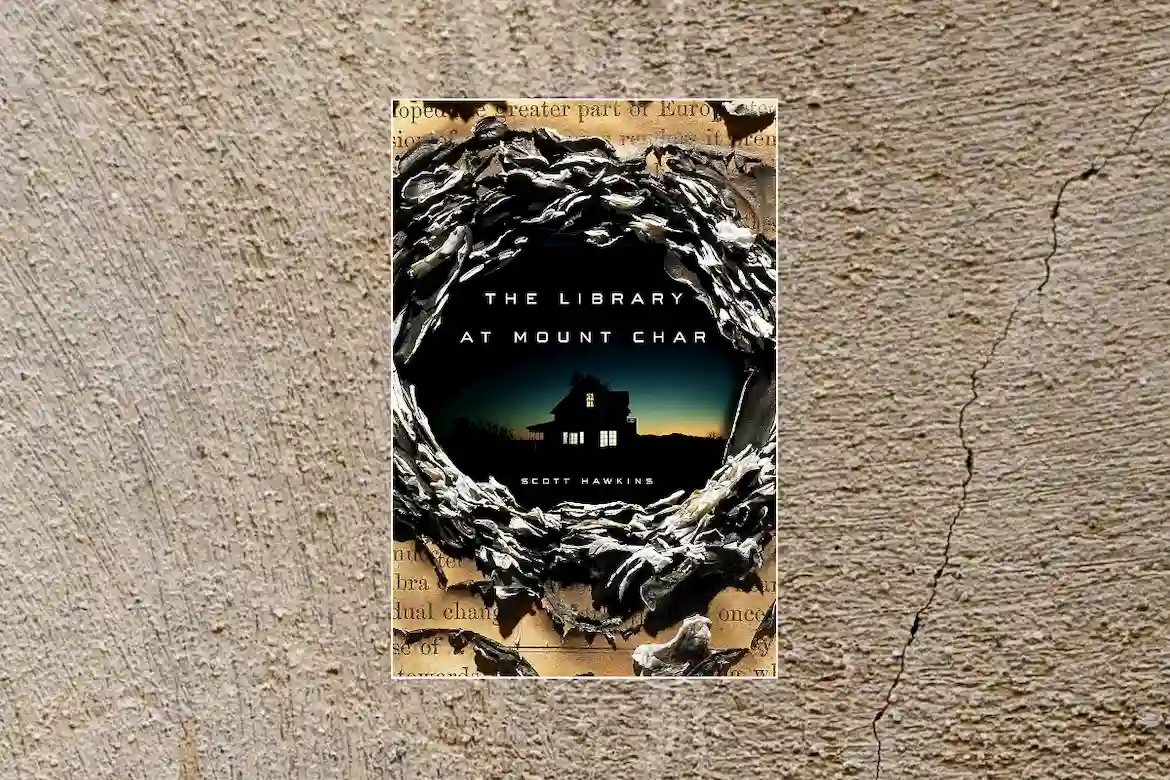
The Library at Mount Char is a genre-defying feat of dark fantasy that dares to drag readers across uncomfortable moral boundaries in pursuit of an unforgettable story.
Scott Hawkins’ novel, The Library at Mount Char, forces us into a fascinating paradox, balancing shocking cruelty against the deep human heart to explore what happens when fiction truly unsettles us. We love that this book was a challenge for us to read and that it upset the balance of the fictional dream for a purpose, to engage the reader’s sensibilities. That’s why we’ve made it this week’s LitStack Rec.
As an affiliate of Bookshop.org, Malaprop’s, Books-A-Million, Audiobooks.com, Chirp, 2nd & Charles, Amazon, NameHero, Envato, and Place-It, LitStack may earn a commission—at no cost to you—when you purchase through our affiliate links. We appreciate the brands we work with, and also appreciate that using our affiliate links may help you find your next great read, a book or two or more, in whatever form, while simultaneously supporting LitStack. When you use our affiliate links, you help keep LitStack running—and for that, we thank you.
You can find and buy the books we recommend at the LitStack Bookshop on our list of LitStack Recs.

In This LitStack Rec of The Library at Mount Char

The Library at Mount Char
by Scott Hawkins
Content Advisory & Trigger Warning
I think you might want to note that The Library at Mount Char contains direct, graphic violence against animals. Additional sensitive themes include graphic physical trauma, child abuse, and intense violence. While these elements serve to establish the brutality of the story’s antagonists and the dark nature of the magic system, they can be disturbing for some readers.
The Moral Paradox of Dark Fiction
I think the point is that Scott Hawkins wanted to move the reader into a paradox; we’re moved into a place of competing emotions; we both care about these characters and their journeys, yet also we accommodate some scary actions from these characters, inside a narrative that sometimes, to be honest, feels as devoid of a moral compass and empathy as the God characters.
We wonder if Hawkins is toying with us (the author interrupts the narrative), and if so (it’s okay), but why? Well, Hawkins knows our basic need for narrative, our hunger for story, our voyeuristic appetite and also the violent and dark, sometimes ruthless evidence of our ever-malleable human nature. He puts us right in the middle of that, and we have to, yikes, this is brave of him, stop reading. We have to think about what we’re feeling, what this text has made us feel, and we have to stop and deal with our competing emotions and desires.
Why I Had To Pause My Reading
The dog fights did it for me. I had to stop. When one of the characters (and later two) are attacked by neighborhood dogs that are under an attack spell, the characters fight and kill some of the dogs. This scene (and one other like it) brought me totally into paradox. I had to weigh the emotional consequences of continuing reading against my desire to read.
Believe me, this book offers fascinating aspects, and the story does engage you. But, like the characters, I had to stop reading and engage in a moral paradox. I had to choose. Did the murder of the dogs cross a line, yes. Could I forgive that and move into the fictional dream? Yes. I made a choice and morally excused my feelings about killing dogs and my strict morality around those feelings. And I made that choice because I wanted to read more of this story. I wanted more of the suspense of this book, especially the feeling that anything could happen and that I did not know or expect what may happen next. This feeling only happens sometimes in fiction, where the bottom drops out of the narrative and suddenly you feel panicked because you don’t have any of the story bearings you would normally rely on to predict and catalogue what could happen next. It’s a scary place to be, and we love being there, so this book made the list.
It’s Okay If Fiction Unsettles Us
The Library at Mount Char by Scott Hawkins is dark and sometimes upsetting. It’s a fantasy novel that blends God mythology, cosmic and human horror, and dark comedy. This is the first time I’ve ever felt compelled to give a trigger warning. Come on, toughen up, fiction is fiction, it’s not real. We have to accommodate subject matter. We invite ruin if we insist on excluding any subject in fiction. Fiction has room. It’s big. It exists to make us think, to move us into emotions and places we are sometimes uncomfortable with.
Overall, The Library at Mt. Char achieves an eerily satisfying reaction. It’s an entertaining piece of fiction that left me both thinking about the moral choices we make in life and yet also left me hoping Scott Hawkins will mature into writing more serious, grounded worlds that present the competing emotions he moves the reader to experience in a more accessible milieu. Despite the conflict his narrative presents to us, and maybe because of the struggle this book poses, The Library at Mt. Char is a LitStack Rec.
War for the Universal Repository
The Library at Mt. Char is an immense, interdimensional repository containing the secret knowledge of the universe. The book follows a group of Librarians, orphans who were taken into the Library at Mt. Char by a godlike entity after their parents were killed in a mysterious tragedy, only for their adopted father to suddenly vanish, triggering a power struggle for control of the universe.
As the children grew up, Father forced each child to specialize in a specific catalogue (or discipline) of universal knowledge, such as animal communication, death, war, or future sight. He enforced strict rules, forbidding them from studying each other’s catalogues under threat of horrific punishment, torture, and death (though Father can also resurrect them and often does kill them and resurrect them).
As the story opens, Father has gone missing, and the children, the Librarians or Librarian-Gods, are locked out of the library by a magical barrier. Carolyn, a master of languages and human behavior, orchestrates a cold, meticulously calculated scheme to navigate the crisis. While her siblings attempt brute-force tactics or crumble under pressure, Carolyn allies with an ordinary human, Steve, a former burglar, to help navigate Father’s ancient enemies and rival gods, and uncover Father’s eventual grand design.
Gods, Monsters, and Mortals
The Librarians
Carolyn, our main character, is Master of the Catalog of Languages, not just human tongues, but the fundamental languages of the universe, including storm-speak and the minds of animals/humans. Beneath her quiet demeanor lies a ruthless strategist capable of extreme cruelty to achieve her goals.
Carolyn’s “siblings” are David who is the Master of the Catalogue of War, who wears a blood-soaked tutu and heavy armor, is a psychopathic killer who revels in horrific violence and torture and is Carolyn’s primary threat among her siblings. Michael who is the Master of the Catalogue of Animals and can communicate with and command all beasts, from domestic dogs to ancient, monstrous predators. There’s Margaret who is the Master of the Catalogue of Death, and she exists in a constant state between life and death, spending time in the underworld. She has a horrific physical appearance, smells of death, and can bring back spirits or decay living flesh. Jennifer, who is the Master of the Catalogue of Healing, and is compassionate compared to her siblings, she can heal any injury or illness, though her powers come at a grim cost. Rachel, who is the Master of the Catalogue of Future Sight and can see timelines and potential futures, though Father heavily restricted how much she could reveal.
The Ancients
Father is an ancient godlike entity who has ruled for millennia. He is cruel, omnipotent, and emotionally distant, viewing human life as trivial. His entire upbringing of the children was a ruthless process to mold a worthy successor to keep the cosmos running.
Nabangutu is a terrifying, ancient rival divinity who opposes Father and seeks to claim the Library for himself.
The Humans
Steve, our other main character, is an ordinary human, ex-convict, and aspiring Buddhist who stumbles into Carolyn’s world and becomes the moral center and human foil to Carolyn’s increasingly cold, godlike perspective.
Erwin is a highly trained military black-ops soldier who gets pulled into the battle between these cosmic beings and proves surprisingly effective against supernatural threats.
The Price of Knowledge: Trauma, Destiny, and Power
When Scott Hawkins strips away the cosmic horror and divine violence of The Library at Mt. Char, what remains is a moving human story about abuse, trauma, power, and the terrifying price of knowledge.
The story is first and foremost an allegory for severe child abuse and survival. Father’s (God’s) method of teaching was systematic destruction, mutilation, starvation, psychological torture, and execution followed by resurrection. While this brutal regimen successfully forged the children into semi-gods, it shattered their capacity for connection.
To survive Father, the Librarians have to trade away pieces of their souls. David is a blood-soaked, psychotic engine of pure rage, Margaret is haunted and physically decayed by her constant communion with the dead, and Carolyn is a terrifyingly cold, calculating strategist who treats humans as disposable. The story explores power dynamics, and asks, when power is bought through extreme trauma, can the person who emerges at the end still be called human?
Godhood vs. Humanity: Empathy, Fate, and Free Will
That tension between godhood and humanity forms the emotional core of the novel. Father and his cosmic peers operate with complete detachment, viewing mortal existence as trivial and short-lived. In stark contrast stands Steve—a flawed, ordinary ex-convict striving toward basic Buddhist principles of compassion and mindfulness. While Carolyn and her siblings wield absolute, reality-bending power, Steve holds the true anchor of the story (and he is the one who fights the dogs). His presence reminds Carolyn of the empathy she lost, forcing her to confront the truth that cold omniscience without human compassion is simply tyranny, and taking stewardship of the cosmos requires hanging onto a thread of everyday human goodness.
Overlaying this struggle is the claustrophobic shadow of fate and free will. Throughout, Carolyn believes she is breaking her chains, outsmarting her abuser, and seizing her own destiny. Yet as the pieces fall into place, she discovers that every death, every strategic sacrifice, every moment of agony, was preplanned, and she is left to find out how you claim true agency when the very tools you use to liberate yourself were designed by the person who enslaved you.
Ultimately, in Hawkins’ novel, knowledge is a double-edged sword. In the Library, understanding how the universe works grants total authority over the universe, but that understanding also breeds absolute isolation. The further the Librarians plunge into their respective Catalogues, the further they drift from the world they once belonged to, leaving them all gods in power, but entirely alone in the dark.
A Daring Debut – We Want More!
The Library at Mt. Char is a weird, darkly funny and original fantasy novel that stands out as one of the most daring and original dark fantasy debuts in recent years. Hawkins manages to mix cosmic horror, intense violence, and pitch-black humor into a novel that is scary because you can’t predict where it’s going. The suspense is that anything can happen, and a lot does. If you like unique magic systems, ruthless characters, and stories about the cost of power, it’s well worth your time.
It’s not an easy read because it depicts some violent episodes and actions, but it balances the disturbing elements with genuine heart and clever storytelling. It sticks with you long after you finish, making it a great pick if you’re looking for fantasy that breaks away from standard genre tropes.
We’re definitely looking forward to reading more from Hawkins. Something more grounded in a realistic milieu that we can grasp more readily, in a world that won’t leave us suspecting maybe he’s toying with us, and maybe, just a little, showing off.
~ J.S. Hood

About Scott Hawkins

Scott Hawkins works as a software engineer for Intel. He and his wife live in Atlanta, where they spend much of their time playing Olympic-caliber fetch with their large pack of foster dogs. The Library At Mount Char is his first novel, and Blacktail, his second novel, arrives on bookshelves September 1, 2026.
You can connect with Scott Hawkins on his website, Facebook and LinkedIn.
Publisher: Crown | Penguin Random House
ISBN Trade Paperback 9780553418620
LitStack Spots by Scott Hawkins and Others
Here are a few LitStack Spots of other titles by Scott Hawkins that you will definitely want to add to your TBR stack, including Blacktail by Scott Hawkins, King Sorrow by Joe Hill, and Lost Boy: The True Story of Captain Hook by Christina Henry.
Other LitStack Resources
LitStack Spotlights
Be sure and check out LitStack Spotlights that shine a light on books we think you should read. We feature two books each week in our LitStack Spotlight, and offer suggestions for similar titles in our LitStack Spots.
LitStack Reviews
Also look at our LitStack Reviews, including reviews by Lewis Buzbee, Lauren Alwan, Allie Coker, Rylie Fong, and Sharon Browning.
LitStack Recs
Each week we offer a LitStack Rec, sometimes two books at once, sometimes more. Be sure and look at our LitStack Recs where you’ll find what you should read next.
You can find and buy the books we recommend at the LitStack Bookshop on our list of LitStack Recs.


As an affiliate of Bookshop.org, Malaprop’s, Books-A-Million, Audiobooks.com, Chirp, 2nd & Charles, Amazon, NameHero, Envato, and Place-It, LitStack may earn a commission—at no cost to you—when you purchase through our affiliate links. We appreciate the brands we work with, and also appreciate that using our affiliate links may help you find your next great read, a book or two or more, in whatever form, while simultaneously supporting LitStack. When you use our affiliate links, you help keep LitStack running—and for that, we thank you.