
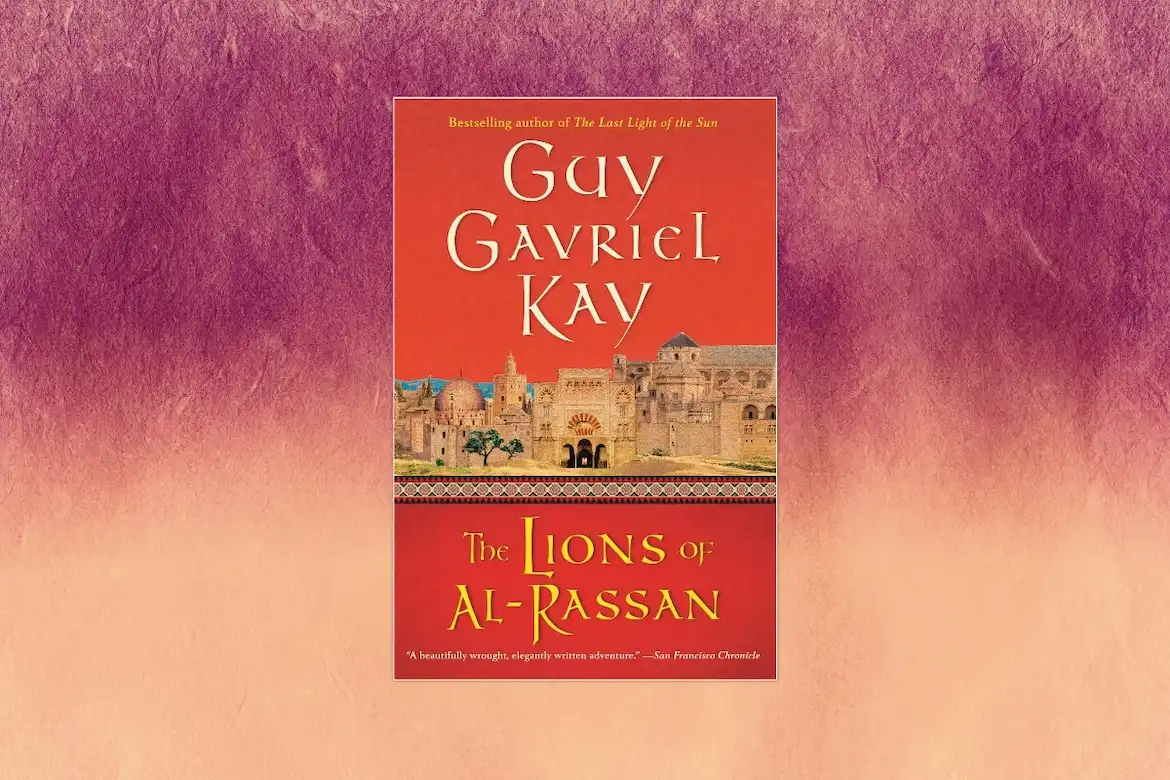
This week’s LitStack Rec is The Lions of Al-Rassan, a masterpiece of historical fantasy that is both a brilliant adventure and a deeply compelling story of love, divided loyalties, and what happens when hardening beliefs begin to remake—or destroy—a world.
As an affiliate of Bookshop.org, Malaprop’s, Books-A-Million, Audiobooks.com, Chirp, 2nd & Charles, Amazon, NameHero, Envato, and Place-It, LitStack may earn a commission—at no cost to you—when you purchase through our affiliate links. We appreciate the brands we work with, and also appreciate that using our affiliate links may help you find your next great read, a book or two or more, in whatever form, while simultaneously supporting LitStack. When you use our affiliate links, you help keep LitStack running—and for that, we thank you.
You can find and buy the books we recommend at the LitStack Bookshop on our list of LitStack Recs.

In This LitStack Rec of The Lions of Al-Rassan

The Lions of Al-Rassan
by Guy Gavriel Kay

The Braid of Empires | A Fragile Golden Age on the Brink
Set in a world that mirrors 11th-century medieval Spain (Al-Andalus) during the turbulent dawn of the Reconquista, The Lions of Al-Rassan is a thoroughly enjoyable and languorous read, a tale of a golden age on the brink of collapse. The story chronicles the shifting alliances and cultural collisions of three distinct peoples: the sun-worshipping Jaddites (Christians), the star-worshipping Asharites (Moors), and the wandering Kindath (Jews).
At the center are three extraordinarily well written characters (the title’s Lions of Al-Rassan) whose lives become inextricably braided. There is Rodrigo Belmonte, a peerless Jaddite military commander; Ammar ibn Khairan, a brilliant Asharite poet, diplomat, and assassin; and a woman who loves them both, Jeane bet Ishak, a fiercely independent Kindath physician. As holy war slowly consumes the peninsula, our three main characters grapple with intersecting loyalties, profound identity conflicts, and a tragic political landscape where history forces Ammar and Rodrigo to confront one another on the battlefield at the novel’s climax.
We never get a clear glimpse of the final battle but we are not disappointed. We experience the battle through the eyes of Jeane bet Ishak. Jeane is on a hillside, and the battlefield is obstructed by a veil of sunlight that reveals not the warriors themselves, but their silhouetted lunges, advances, feints and falls, and ultimately, the death of one of them, though we don’t know which. The last pages of the book unravel these mysteries, the singular battle and its aftermath revealed to us as the narrative revisits the battle through memories and present day situations.
The weaving structure (prolepsis) is expertly achieved, and wrought to perfection in the book’s final section, the battle through novel’s end. Though the battle is near book’s end, it is hundreds of pages earlier when Ammar and Rodrigo first meet that we learn these two warriors are destined to meet in battle and that only one will survive. We don’t find out the truth until long after the battle, when the future reveals to the reader the tragedy and sorrow that emerges from the silhouetted past, the golden age fallen.
Challenging and Subverting Conventional Narrative
As a book reviewer, I look for stories that challenge and subvert conventional and derivative boundaries of narrative structure. Guy Gavriel Kay’s The Lions of Al-Rassan offers a unique reading experience that is intellectually thrilling, emotionally devastating, and incredibly satisfying.
If you enter this book completely blind to the history that inspired it (as I did), you are not at a disadvantage, you are in for a profound treat. Kay doesn’t require you to do any historical homework. Instead, he invites you to lose yourself in a languorous read that creates suspense with prose woven from fine-spun narrative threads that slowly bind and trap you in the novel’s web of imagination and suspense.
The Architecture of Suspense | Foreshadowing as a Crescendo
What makes The Lions of Al-Rassan a truly satisfying read is its unique weaving structure. Kay relies heavily on prolepsis which is a technique where the narrator subtly reveals future outcomes first, and then leads you in suspense to the reality of outcomes, revealing surprising unknown subtleties, quiet moments and shattering violence that twist the future into something your imagination could not conceive. It’s as if, finally, after aeons, you are freed from the vagaries cast in the allegory of the cave. Truth is subjective, perceived as darkened shapes, and this novel’s structure reveals a Rashomon kaleidoscope of truths that replace the shadows of mystery.
This creates a brilliant narrative paradox. In chapter after chapter, by giving away bits of the future, Kay doesn’t spoil the story; he creates a stepped crescendo of suspense and mystery that builds to the novel’s finale. You are pushed forward by an insatiable need to discover the truth of events you already know are coming. It turns the act of reading into a countdown, forcing you to scan every sentence for the tripwires of fate. It causes your imagination to create scenarios you believe may happen, and then turns and subverts your expectations, giving you a deeper understanding of and appreciation for the vagaries of history, and the contradictory nature of competing perspectives.
The Ultimate Payoff is Satisfying Facts and Heart-Wrenching Twists
When foreshadowed events are finally fleshed out, as I said, most notably during the novel’s legendary final duel, Kay delivers a masterclass in execution. He expertly manages the reader’s expectations and imaginations to create a dual effect:
The Satisfaction of Discovering Truth: The narrative finally gives you the hard facts of its events, relieving the tension built across hundreds of pages.
The Sting of the Unexpected: In the process of satisfying the suspense, Kay deploys twists and subtle shifts in perspective, revealing deep emotions and insights that you never saw coming, a technique that leaves you contemplating your own perspective of lived events. We don’t simply read this book, we experience it on a personal level.The novel lingers with you long after its last words; the expansive narrative leaves you in awe, its woven spell casts your gaze back upon yourself to question the shadings of meaning from your own life’s silhouetted events and choices.
Subtlety that Elicits Deep Emotion
The novel’s momentum is driven by subtleties. This is not high fantasy, it is historical fantasy. There are no loud, derivative magical solutions to the problems in Al-Rassan. Instead, you are steeped in an entirely believable history, yet one that seems at key moments to be a world no human has experienced. The story of its characters’ profound identity conflicts moves forward in quiet interactions: a shared look across a courtyard, a line of poetry delivered with double meaning, a slight change in a warrior’s stance; these are the magical moments of this epic.
Because Kay takes his time, allowing the pacing to breathe, as if the narrative lingers in the sun-drenched beauty of the vanishing golden age, the emotional payoff is staggering. You don’t merely witness history; you feel the personal weight of unavoidable tragedy. This is a book you will wish was longer. Fortunately, it takes its own precious time and begs your patient attention to experience its gifts.
Our Verdict
The Lions of Al-Rassan is a rare achievement in historical fantasy literature. The book respects and yet demands your patience, plays brilliantly with your expectations and anticipation, and rewards the suspense of your journey with a perfect blend of structural genius and raw, unfiltered emotion. Do yourself a favor: sit down with this book, read slow, expect to take a long time, and allow Kay to weave the magic of The Lions of Al-Rassan into your heart and mind, shifting your perspective of history and, inevitably, casting your contemplation toward uncovering your own shadows and feints, the truths in your own personal history.
The Lions of Al-Rassan is a triumph, an unmatched historical fantasy epic, and we highly recommend you fill your reading time with its brilliance.
~J.S. Hood
About Guy Gavriel Kay

Guy Gavriel Kay is a #1 international bestselling Canadian author renowned for his “history with a quarter-turn to the fantastic.” His unique subgenre blends meticulous historical research with subtle supernatural elements, reimagining settings like Tang Dynasty China (Under Heaven) and Renaissance Italy (A Brightness Long Ago).
Before his own debut, Kay moved to Oxford to assist Christopher Tolkien in the editorial reconstruction of J.R.R. Tolkien’s The Silmarillion. A qualified lawyer and member of the Order of Canada, Kay is a two-time Aurora Award winner and recipient of the World Fantasy Award for his 2007 novel, Ysabel.
Publisher: Harper Voyager | HarperCollins
ISBN Trade Paperback 9780060733490
Other Titles by Guy Gavriel Kay
We’re also recommending these other titles by Guy Gavriel Kay, though you cannot go wrong with his books and we encourage you to collect and read them all. That’s what we’re doing, buying and reading every one of his books, including Tigana, The Last Night of the Sun, and Under Heaven.
Other LitStack Resources
LitStack Spotlights
Be sure and check out LitStack Spotlights that shine a light on books we think you should read. We feature two books each week in our LitStack Spotlight, and offer suggestions for similar titles in our LitStack Spots.
LitStack Reviews
Also look at our LitStack Reviews, including reviews by Lewis Buzbee, Lauren Alwan, Allie Coker, Rylie Fong, and Sharon Browning.
LitStack Recs
Each week we offer a LitStack Rec, sometimes two books at once, sometimes more. Be sure and look at our LitStack Recs where you’ll find what you should read next.
You can find and buy the books we recommend at the LitStack Bookshop on our list of LitStack Recs.
As an affiliate of Bookshop.org, Malaprop’s, Books-A-Million, Audiobooks.com, Chirp, 2nd & Charles, Amazon, NameHero, Envato, and Place-It, LitStack may earn a commission—at no cost to you—when you purchase through our affiliate links. We appreciate the brands we work with, and also appreciate that using our affiliate links may help you find your next great read, a book or two or more, in whatever form, while simultaneously supporting LitStack. When you use our affiliate links, you help keep LitStack running—and for that, we thank you.