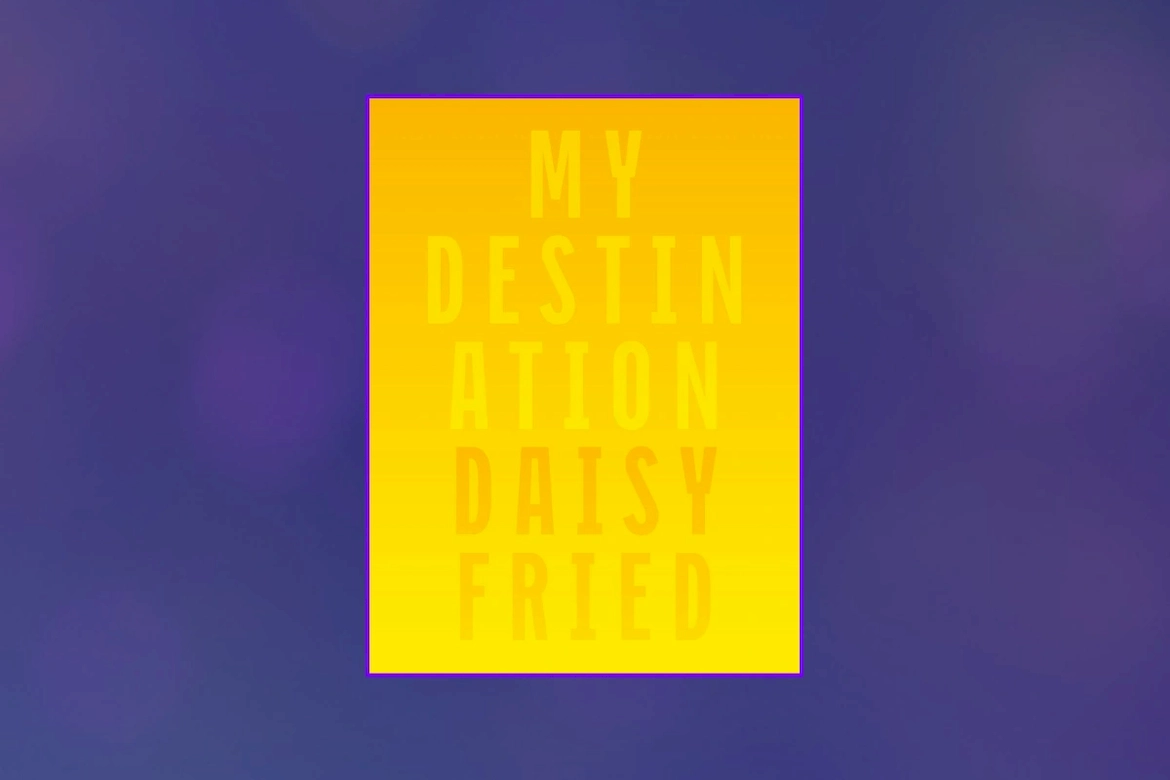
For this LitStack Review, we present Kathy Nelson’s review of My Destination, a collection of poems by Daisy Fried that explores an exquisite story of grief.
As an affiliate of Bookshop.org, Malaprop’s, Books-A-Million, Audiobooks.com, Chirp, 2nd & Charles, Amazon, NameHero, Envato, and Place-It, LitStack may earn a commission—at no cost to you—when you purchase through our affiliate links. We appreciate the brands we work with, and also appreciate that using our affiliate links may help you find your next great read, a book or two or more, in whatever form, while simultaneously supporting LitStack. When you use our affiliate links, you help keep LitStack running—and for that, we thank you.
In This LitStack Review of My Destination
My Destination
by Daisy Fried
I. The Anatomy of Heartache
My Destination, the fifth poetry collection in Daisy Fried’s body of work, is a study in grief. I use the word “study” in the sense of Da Vinci’s drawings: pages of detailed sketches, a shoulder, a foot, one view juxtaposed against another. Like any other fully grown adult human being, Fried knows sorrow. And she expertly transcribes the experience in all its complexity, from many angles and in detail. But it would be a mistake to expect from this masterful poet a simple inventory, a straightforward narrative, a tone of reverent nostalgia or the merest hint of sentimentality. Fried is a master at engaging, challenging the reader as a participant in the painful lived experience of loss.
This book is, in a sense, a companion to Fried’s most recent previous collection, The Year the City Emptied, a book of translations of several of Baudelaire’s Fleurs du Mal. There, she adapts Baudelaire’s voice to describe a 2020 world of isolation, lament, pestilence and corruption. In her introduction to The Year the City Emptied, Fried explains that she undertook the book during her husband’s final illness. As if it were a continuation, My Destination begins with a prologue poem, another translation, this one of Baudelaire’s, “Les Hiboux.” But Fried renders its final words, in Baudelaire’s version a third-person moral, as first-person introspection: My punishment for desiring change / Is desiring more change.
II. Delay
Fried does not spoon feed her reader. “Goose after Goose,” first published in American Poetry Review, plunges, without context or scene-setting, right into an emotional landscape:
I stomped the brake
and honked so hard
in my anger
they slid,
the legal pads,
…
filled with pages on pages
of his writing
no one would ever read.
Only in Section 2 do we learn that the occasion is a funeral, but whose? Section 3, the longest of the four sections, moves as many of these poems do, from the present to the past, into memory, the speaker’s scientist father banding geese. Here, well into the poem, we begin to suspect the funeral is the speaker’s father’s.
We must wait, however, for the final section for a more personal glimpse of him:
he danced ecstatic
hugging the Torah scrolls,
same, I said, as he danced
when I was little, planting feet
gyrating to some rock song,
face contorted, hands wheeling
on his wrists like pennants
Soon, we intuit the importance of those legal pads in the opening.
There were his poems, solemn and brainy.
We worked on them together
last time I saw him. I liked them.
Here, near the poem’s end, the patient reader finds this eloquent expression of the speaker’s affection. Delay of critical information—identity, personality, father-daughter connection—heightens the emotional impact of the speaker’s pain. Understated, sorrow is powerful.
III. Misdirection
Delay isn’t Fried’s only tactic for heightening the impact of bereavement. Subtitled an elegy, “The Jumblies” presents the speaker’s daughter seeking food for her pet snake. It’s uncomfortably detailed, a bit grizzly, the telling: “live worm chunks … rubbed …with mouse gut, … a stew of worm and mouse.” Nearly all the poem’s real estate is taken up with this story. But two of the section titles (BACK ROOM AT MONSTER PETS. MY MOTHER IS DYING. and IN HER ROOM. MY MOTHER IS DEAD.) tell another story. The snake story is engaging, creepy. We almost forget this poem’s an elegy until, near the end of section 1, “My mother was thinking of dying” and “I am thinking of my mother.”
In the middle section of “The Jumblies,” its center of gravity, we understand the metaphorical purpose of the snake story:
…her father, unsolvable problem,
mostly absent because mostly sick, maybe losing his mind,
makes us what? Lonely. And tethered. And free.
And makes me shout. Doesn’t make: I let myself shout.
So think of me shouting, snake with mouth unhinged
to fit a universe of mice. Not at her but do we think
anger is a good green place for her to live in?
Mother and daughter are in the midst of misery, the mother unhinged by caregiving, the daughter as in need of a quiet place to live as any innocent creature. The way Fried wields metaphor is remarkable.
“The Jumblies” employs misdirection: an elegy which is actually a snake story, a snake story which is actually an elegy. “Fasces,” the first section’s first poem, uses a similar strategy. There, several stories interweave: a scene of violence the speaker witnesses on leaving a train, a history of conflict with her brothers, each of these stories about anger. But dropped in casually, with a deft line break, is a reference to the speaker’s husband.
…My unforgiving, strongman
brother sent me a limerick mocking my husband,
who was dying
And the poem ends with a simile: “like bleeps on a dying man’s EKG.” There’s sleight of hand at work in these poems: hide suffering in an engaging story about something else.
IV. A Narrative of Loss
While My Destination employs delay and misdirection to address its central topic, and while the plain story of the husband’s illness—the caregiving, his dying—is absent from the collection, Fried is quite capable of constructing a simple narrative that makes us feel what profound regret feels like. “Let’s Fly to the Castle!,” the fourth section of “Quickies in Widowhood,” addresses her dead husband:
It wasn’t your bomber, old boots,
duplicate copy of the Shaw bio,
or your wheelchairs that made me
feel I couldn’t breathe—
Beginning with negation, she tells him what grief wasn’t. She denies nostalgia, avoids the melodrama of a weeping widowhood.
Then, she paints for her husband a picture, tells him how she accidentally placed their daughter’s (“our girl’s”) toy ponies in a garbage bag and left them out for collection, how she watched, bereft, as the garbage truck left with the bag.
Guilty, crying, I dashed
to save, save them…
and ran barefoot, no bra.
All I saw was the garbage truck,
the men hanging on,
disappearing round the corner,
pale pony princess
with blue and green
artificial hair, churning in its maw.
We are made to feel the desperate urge to save what’s (or who’s) being lost, along with the inevitable guilt. And we are made to feel the grinding, impersonal quality of the unpreventable end of life.
V. “If I kept singing I could keep you here”
I’ve highlighted a few poems that address anguish in Fried’s anti-sentimental way. There are many more, for example, “If I kept singing I could keep you here” tucked into a long poem about the speaker’s daughter’s church singing (“No God in Us but Song”). At every turn, the reader becomes engrossed in a seemingly normal story of ordinary life only to be reminded, surprised all over again (and isn’t that exactly how we experience grief?), by agony that arrives more powerfully because it is understated. And many poems address not sadness, not directly, but its corollary, anger (e.g., “Faces,” “A Monkey Thing”). All this accomplished with a remarkable acumen for craft: sound, syntax.
One might expect a conventional arc across this book: despair to resolution, darkness to light. Indeed, there are poems that mention a first crush after the husband’s death (“Quickies in Widowhood”), or a new primary relationship (“Barrel of Monkeys”). But Fried is all about subverting our expectations. After all, the penultimate poem (“After the Idea of the Flood Recedes”) is about a dream of butchered animals in market stalls. With delay and misdirection, using the loss of toy ponies as a metaphor for the death of a loved one, making from the story of a daughter’s snake a portrait of the terrain of mourning, Fried tells us her exquisitely painful story, but she tells it slant.
Daisy Fried is the author of five books of poetry: My Destination (2026), The Year the City Emptied (2022), Women’s Poetry: Poems and Advice (2013), My Brother is Getting Arrested Again (2006) a finalist for the National Book Critics Circle Award, and She Didn’t Mean to Do It (2000) which won the Agnes Lynch Starrett Prize. She has been awarded Guggenheim, Hodder, and Pew fellowships, a Pushcart Prize, the Cohen Award from Ploughshares, and a Poetry magazine Editors Prize for the feature article “Sing, God-Awful Muse!,” about reading Paradise Lost, breastfeeding, and the importance of difficulty. A poetry critic and a member of the faculty of the Warren Wilson College MFA Program for Writers, she lives in San Francisco.
Here are other must-buy books of poetry by Daisy Fried that you need for your TBR stack, including Women’s Poetry: Poems and Advice by Daisy Fried, My Brother is Getting Arrested Again by Daisy Fried, and She Didn’t Mean To Do It by Daisy Fried.
In 2019, Kathy was awarded the James Dickey Prize (Five Points: A Journal of Literature and Art). She is the author of the full-length collection, The Ledger of Mistakes (Terrapin Books, 2023), as well as two chapbooks: Cattails (Main Street Rag, 2013) and Whose Names Have Slipped Away (Finishing Line Press, 2017). Her poems have appeared in Asheville Poetry Review, Southern Poetry Review, Tar River Poetry, Valparaiso Poetry Review, New Ohio Review, Rogue Agent Journal and elsewhere. She holds an MFA from the Warren Wilson Program for Writers.
Be sure and check out LitStack Spotlights that shine a light on books we think you should read. We feature two books each week in our LitStack Spotlight, and offer suggestions for similar titles in our LitStack Spots.
Each week we offer a LitStack Rec, sometimes two books at once, sometimes more. Be sure and look at our LitStack Recs where you’ll find what you should read next.
You can find and buy the books we recommend at the LitStack Bookshop on our list of LitStack Recs.
As an affiliate of Bookshop.org, Malaprop’s, Books-A-Million, Audiobooks.com, Chirp, 2nd & Charles, Amazon, NameHero, Envato, and Place-It, LitStack may earn a commission—at no cost to you—when you purchase through our affiliate links. We appreciate the brands we work with, and also appreciate that using our affiliate links may help you find your next great read, a book or two or more, in whatever form, while simultaneously supporting LitStack. When you use our affiliate links, you help keep LitStack running—and for that, we thank you.