
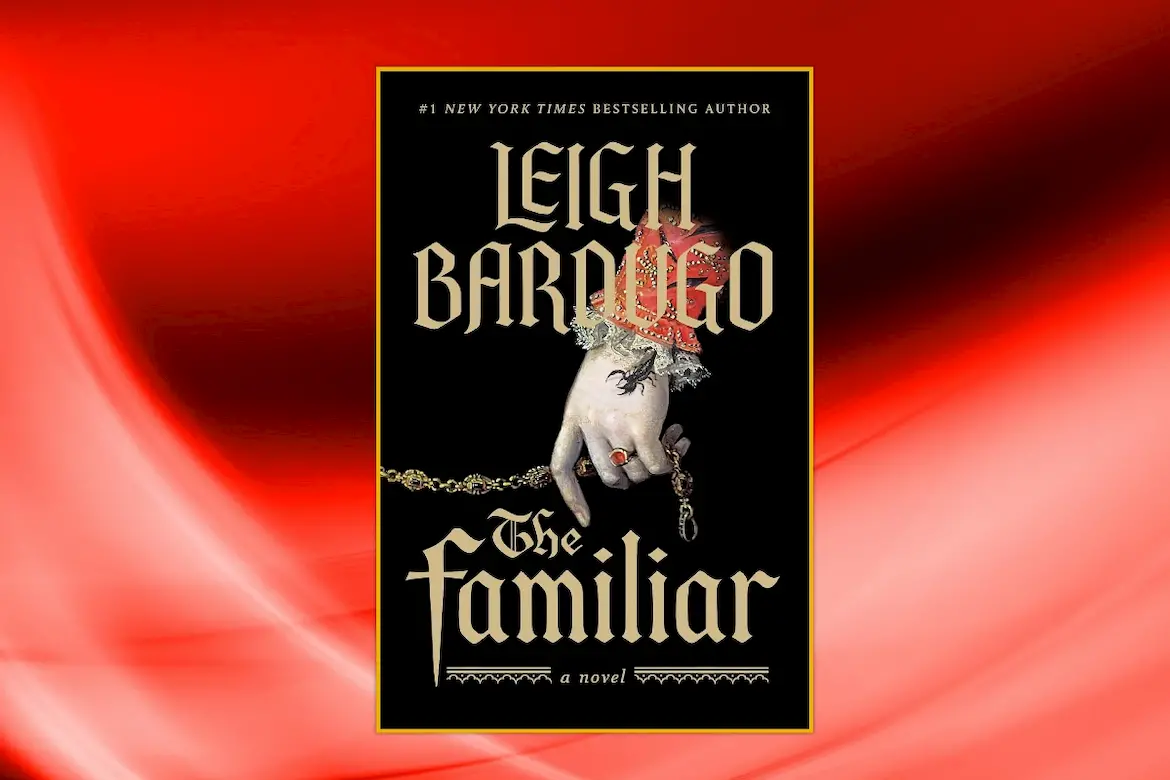
It’s true, we love The Familiar by Leigh Bardugo in this LitStack Rec. The Familiar is a miracle. It is a knockout.
As an affiliate of Bookshop.org, Malaprop’s, Books-A-Million, Audiobooks.com, Chirp, 2nd & Charles, Amazon, NameHero, Envato, and Place-It, LitStack may earn a commission—at no cost to you—when you purchase through our affiliate links. We appreciate the brands we work with, and also appreciate that using our affiliate links may help you find your next great read, a book or two or more, in whatever form, while simultaneously supporting LitStack. When you use our affiliate links, you help keep LitStack running—and for that, we thank you.
In This LitStack Rec of The Familiar

The Familiar
by Leigh Bardugo
Forget what you think you know about historical fantasy fiction. The Familiar is entirely different. The Familiar is a miracle. It is a knockout book, brilliantly told with restraint, subtlety and ambiguity enough to build into an exciting, at times thrilling, operatically-crafted ride, an alluring and enveloping narrative full of emotion and mystery. Set in 16th-century Madrid during the Spanish Inquisition, Bardugo’s The Familiar isn’t just a backdrop for magic—it’s a vibrant, breathing, living world, meticulously researched, with some scenes that are heart-breakingly tender, and a story that is inspiring and dramatic. Congratulations to Bardugo on The Familiar, the book we love in this LitStack Rec.
Survival and Ambition
At the heart of the story is Luzia Cotado, a young scullion maid with a secret power that could mean her life during a time of violent religious suppression. Luzia can perform little miracles (milagras). These aren’t dramatic, world-shaking spells of standard fantasy fare. No, these are simple spells from her Sephardic Jewish ancestry, built from many translations of many languages that seem to form a language of their own–magic at once all languages and no languages. As the book opens, the third person narration immediately hooks you with its incantation.
If the bread hadn’t burned, this would be a very different story. If the cook’s son hadn’t come home late the night before, if the cook hadn’t known he was hanging around that lady playwright, if she hadn’t lain awake fretting for his immortal soul and weeping over the future fates of possible grandchildren, if she hadn’t been so tired and distracted, then the bread would not have burned and the calamities that followed might have belonged to some other house than Casa Ordono, on some other street than Calle de Dos Santos.
Like the “if” incantations that open the book, the opening promises that what will follow will have subtle movement of character, a story nuanced, built to pull your emotions into a world of magic, reawakened possibilities and love, and let you splendor in its classical dramatic journey. What an incredibly fulfilling read. The story starts with one subtle, clever act of magic, Luzia’s maligra renders the bread unburned. When her ambitious mistress Dona Valentina sees this trick, and others, and discovers the girl’s abilities, Luzia is thrust into a dangerous world of courtly intrigue and political machinations. It’s a classic tale of a person with no power trying to survive against those who have power, but with a personal magical ingredient that makes the read even more compelling.
Prose That Weaves a Spell
Bardugo’s prose is at times breathtakingly restrained and entirely seductive and emotional.
She doesn’t just describe 16th-century Madrid. She gets underneath the skin of every character, each of whom lovingly wears their faults with a kind of pride that renders them humanistic. You can smell the spices in the kitchens, feel the scratch of the rough-spun fabric on Luzia’s skin, and taste the fear in the air when the Inquisition is mentioned. The language is lyrical and evocative, and there are short Ladino proverbs that Luzia uses to ground her magic, and at once, cleverly used to reveal character. These refranes are more than just flavor text; they are an integral part of Luzia’s character, and examples of her burgeoning power. The magic here is deeply personal and rooted in the sadness of absence–that she must, in everything she does, hide and erase her cultural and religious identity for fear of death.That it is only in her utterings–her singing of words–when she is fully revealed and set free.
Unforgettable Characters and a Tender Romance
Luzia is a phenomenal protagonist. She’s not the chosen one, destined for greatness; she’s a survivor. Witty, pragmatic, and fiercely determined, she’s a heroine you come to love. Her journey with The Familiar of the title is one of self-discovery and love, as she learns to not only harness her magic but to embrace the identity she has been forced to hide her entire life. The secret of course is her magic.
She didn’t know how to answer. Her refranes were Spanish and Hebrew and Turkish and Greek. They were none of those things. They changed depending on what part of the world the letter came from. They were words battered and blown to all corners of the map, then returned to her, as the people who spoke them could never return.
And then there’s Guillén Santángel, the embittered and mysterious immortal (who looks near death) that is The Familiar of the title, also known as “the Scorpion.” Santángel–a familiar, is bound by a curse to serve a ruthless for the benefits of his master Víctor de Paredes (both Valentina’s patron and Santángel’s master), a ruthless and manipulative merchant who controls Santángel through his curse and seeks to exploit Luzia’s magic for his own gain with the King.
Santángel experiences a slow-burn reawakening and romance with Luzia for some of the most compelling and beautifully written parts of the novel. The scenes between Lucia and Santángel are incredibly sensitive and well written, evoking our emotions. The dialogue is fiercely restrained, but imbues mystery and ambiguity, and is striking in the way it reveals character. When Santángel tells Luzia a story at her request, it is one of the most intimately quiet and sensual scenes in the book. Bardugo handles the romance dynamic with an expert hand, proving that the most profound intimacy can be found in a shared glance or a moment of quiet understanding, though believe me, when the passion soars, Bardugo’s writing achieves flight.
Deeply Resonant
The Familiar is a heart-rending depiction of a woman on the outskirts of her community, someone hiding her identity and past, living a double life in order to survive, to be passable. This book says something important. The central theme of persecution and resilience, particularly for the Sephardic Jewish community in Spain, is handled with a subtle and yet gentle sensitivity that is both educational and deeply moving. Bardugo, herself of Sephardic Jewish ancestry, gracefully weaves an honest history into the fabric of the story, shedding light on a painful period, allowing its importance today to resonate on its own against her narrative. The novel explores how faith, whether genuine belief or a political tool, can be abused to control and oppress. It’s a powerful critique of a world where one’s very existence can be deemed a heresy on religious grounds..
The Familiar is about discovering your place in a world that tries to erase you, about the power of ambition, and about what it means to be truly free. It’s a book that is part historical novel, part fantasy, and part romance—but completely wonderful. The Familiar transported us to another time, let us care about captivating characters who had an emotionally engaging story, and left us, after its amazing ending, thinking about tiny acts of fate, and love, commitment, survival. We’re very close to saying that The Familiar is one of LitStack’s favorite fantasy reads this year.
~ J.S. Hood
All rights reserved by author for quotes from The Familiar, Bardugo, Leigh,
Flatiron Books, trade paperback ISBN 9781250884275, Pub Date 2024

About Leigh Bardugo, Author of The Familiar

Leigh Bardugo is the #1 New York Times bestselling author of Ninth House and the creator of the Grishaverse (now a Netflix original series) which spans the Shadow and Bone trilogy, the Six of Crows duology, the King of Scars duology—and much more. Her short fiction has appeared in multiple anthologies including The Best American Science Fiction and Fantasy. She lives in Los Angeles and is an associate fellow of Pauli Murray College at Yale University.
You can connect with Leigh Bardugo on their website, at Instagram, Facebook, and Pinterest.
Publisher: Flatiron Books | Macmillan
ISBN: trade paperback 9781250884275
Pub Date: 2024
Other Titles by Leigh Bardugo, Author of The Familiar, and another LitStack Rec by Silvia Moreno-Garcia
Other LitStack Resources
LitStack Spotlights
Be sure and check out LitStack Spotlights that shine a light on books we think you should read. We feature two books each week in our LitStack Spotlight, and offer suggestions for similar titles in our LitStack Spots.
LitStack Reviews
Also look at our LitStack Reviews, including reviews by Lewis Buzbee, Lauren Alwan, Allie Coker, Rylie Fong, and Sharon Browning.
LitStack Recs
Each week we offer a LitStack Rec, sometimes two books at once, sometimes more. Be sure and look at our LitStack Recs where you’ll find what you should read next.
You can find and buy the books we recommend at the LitStack Bookshop on our list of LitStack Recs.



Comment Using Emote
As an affiliate of Bookshop.org, Malaprop’s, Books-A-Million, Audiobooks.com, Chirp, 2nd & Charles, Amazon, NameHero, Envato, and Place-It, LitStack may earn a commission—at no cost to you—when you purchase through our affiliate links. We appreciate the brands we work with, and also appreciate that using our affiliate links may help you find your next great read, a book or two or more, in whatever form, while simultaneously supporting LitStack. When you use our affiliate links, you help keep LitStack running—and for that, we thank you.