
In this double LitStack Rec, we’re diving into Gary Shteyngart’s Little Failure, a memoir that peels back the layers of the immigrant experience with agonizing honesty and sharp humor. Then, we pivot to the shadowy, mercantile machinations of K. J. Parker’s The Company. Whether you’re navigating the cultural friction of 1970s Queens or the ruthless colonial logistics of a fictional empire, both authors masterfully explore what happens when the best-laid plans meet the messy reality of human nature. Grab your coffee—it’s time to unpack some brilliant cynicism.
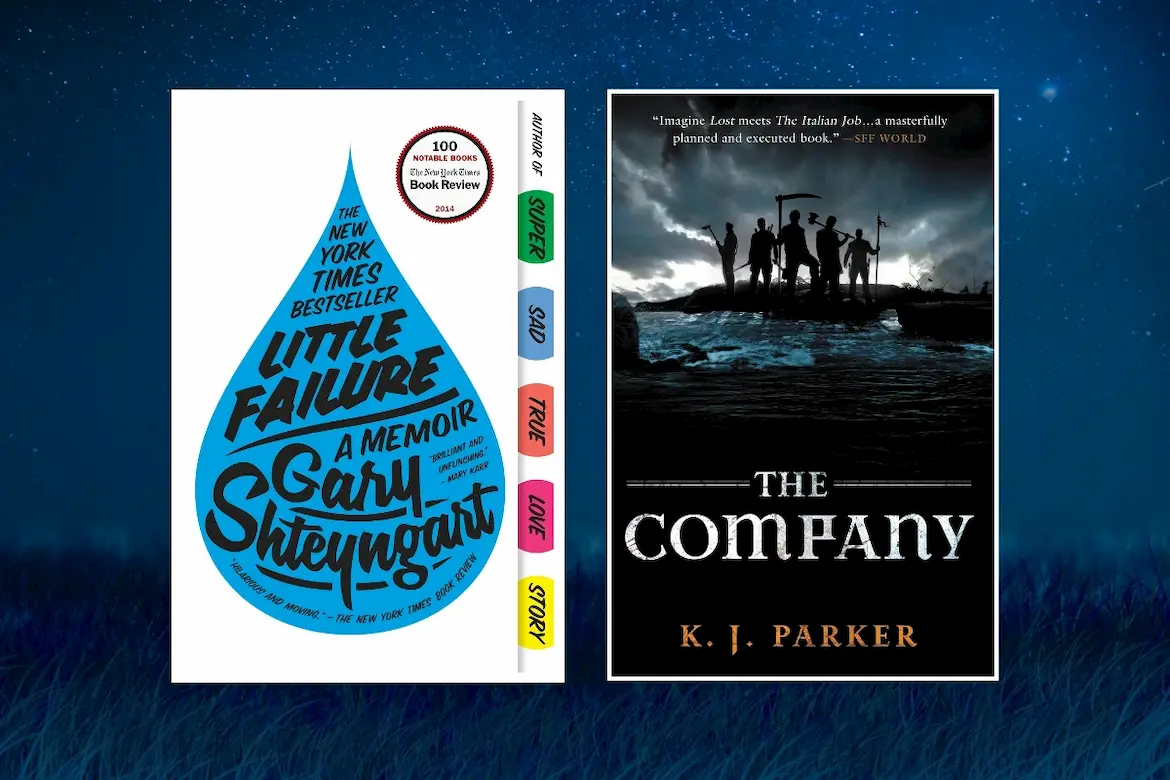
You can find and buy the books we recommend at the LitStack Bookshop on our list of LitStack Recs.

In This Double LitStack Rec of Little Failure and The Company

Little Failure ~ A Memoir
by Gary Shteyngart

“In order for me to be born,” Gary Shteyngart says early on in his memoir, “all four branches of my family have to end up in Leningrad, trading in their tiny towns and villages for that somber, canal-laced cityscape. Here’s how it happens.”
Voice, more than anything, can drive a story and make a book impossible to put down. The immediacy, the candor, the variations in tone that can run from ironic to wry, to the insightful and even lyrical—as readers, we hear the words more than read them, and the best narrative voices create a persona in which there is no discernible line between the speaker’s character and the reader’s ear. The voice in Little Failure achieves this with ease. It’s all there, candid, skewed and idiosyncratic, a knowing, examining, confessing self that doesn’t hold back. Though let’s be clear, Gary Shteyngart is a master storyteller, one who, in this memoir, holds up his own and his family’s history and presents all the facets.
Shteyngart is the author of three previous books—the novels The Russian Debutante’s Handbook, Absurdistan and Super Sad True Love Story—and Little Failure is his first book of nonfiction. As evident from the opening quote, it tracks the family history that led to Gary, but the central story is one of immigration, assimilation and (for the only son), the coming-of-age story of a writer.
The memoir’s title is taken from the pet name his mother bestowed, a mash-up of Russian and English, Failurchka, in its way, meant affectionately. Its derivation can be traced back to the endearment Soplyak, or Snotty, which came via his father, inspired by the runny nose that plagued Gary in childhood. This layer of disappointment beneath love drives the memoir’s voice and the tone, a humming tension beneath the portrayal family love and its complexity.
The book is also about growing up as an outsider in the boroughs of New York. It’s 1979, and young Gary (or Igor, as he’s still going by his Russian name then), has arrived in Queens with his parents and grandparents:
The first momentous thing that happens to me in Kew Gardens, Queens, is that I fall in love with cereal boxes. We are too poor to afford toys at this point, but we do have to eat. Cereal is food, sort of. It tastes grainy, easy and light, with a hint of false fruitiness. It tastes the way America feels.
The voice is central to the young, sensitive and impressionable Gary. “A writer,” he says, “is just an instrument too finely set to the human condition.” As the only child, he is both the center of his parents’ world and a stranger to it. “I needed my mother,” he writes, “needed her company and her dark hair to braid during the moments when I was too tired of reading a book. But I felt the explosive nature of my father’s love for me…and his fire both scared and entranced me.”
We see Gary enter Hebrew school, and he doesn’t dress or speak or act like his classmates. “Here, at age seven, begins my decline.” He makes friends whose glorious American homes he “lacks the vocabulary to describe.” It’s this exposure, one that comes with going to school, that separates and defines immigrating generations, a divide that occurs between Gary and his parents—beginning with Hebrew school in Queens, then the prestigious Stuyvesant High School in Manhattan, to Oberlin College.
Coming of age in the 1980s, Little Failure tracks the Reagan era, a time of a particularly avid kind of Americanism, defined by the nuclear bomb television saga, “The Day After,” and Nancy Reagan’s “Just Say No” drug campaign, by Duran Duran and Billy Idol. The excesses of the decade make for great contrast to the Russian émigré experience, and in their way, form the basis of sixteen year-old Gary’s burgeoning Republicanism:
On election day 1988, I come to the Marriott Marquis ballroom thinking, This is the day. The day I will finally get laid.
Sure, there’s plenty of irony, and 1980s culture, amid the experience of leaving Cold War Russia and navigating the alarming wonder of capitalism. But it’s also a family story, and the story of a writer. Near the memoir’s end, Shteyngart writes:
After finishing the book you hold in your hands, I went back and reread the three novels I’ve written, an exercise that left me shocked by the overlaps between fiction and reality I found on those pages, by how blithely I’ve used the facts of my own life, as if I’ve been having a fire sale all along—everything about me must go!
That voice is one I want to keep reading, fiction and nonfiction, disappointments and all.
~Lauren Alwan
About Gary Shteyngart

Gary Shteyngart is a Soviet-born American author acclaimed for his razor-sharp satire and poignant exploration of the immigrant experience. Born in Leningrad in 1972, he moved to the United States at age seven, an experience he later chronicled in his bestselling memoir, Little Failure.
He first gained prominence with The Russian Debutante’s Handbook and followed with the critically acclaimed Absurdistan. His 2010 novel, Super Sad True Love Story, became a cultural touchstone for its dystopian wit. Recently, he released the 2025 novel Vera, or Faith, a “bitterly funny” tale of a modern family in an unstable America.
Other Titles by Gary Shteyngart
Here are a few other LitStack Spots of titles by Gary Shteyngart, including Vera, or Faith and Lake Success.
The Company
by K. J. Parker
The characters that populate The Company are, without a doubt, some of the most carefully constructed characters that I have encountered in many a year of avid reading. Not because they are lavishly described – they aren’t – but because the language used to describe them and their actions is so lucidly brutal. Even the names – at first difficult, thick with some unknown ethnicity – feel rustically real even in their unfamiliarity: Kudei Gaeon, Aidi Proiapsen, Muri Achaiois, Thouridos Alces, and the central character of Teuche Kunessin. These five men form the legendary A Company (of which army, of which war, we don’t know, and it ultimately doesn’t matter), seasoned fighters who lasted years in a role where most survived weeks, if not days.
At the onset of the book, their war is over. The men of A Company, these “Faralia boys” (for they all came from the same nondescript township on the same barren coast), had left the military and returned home, except for Teuche Kunessin. It is Teuche’s return (now a retired general) that sets in motion the main action of the book: the realization of his dream of the colonization of an abandoned island. But while the preparations and establishment of the colony on the island of Sphoe serves as the major backdrop of the book, it exists in great part as a hingepoint for the glimpsed stories of the men (and women) that led them to that speck of land.
The land – like the text – is sparse, grim, even bitter. There is no grace here, and very little beauty. The beauty that does exist is only a side note, as if glimpsed out of the corner of the eye. What draws us in is not the anticipatory plot twists (although those do exist), but the sheer force that exists from a complete lack of romanticism. The men of A Company are strong, bullish, brutish heroes, yet they are far from heroic. Teuche is brilliant in his ability to manipulate and simple in his need to do so, but he is neither vile nor admirable in his motivations or actions.
It is the bond (or perhaps bondage?) of friendship that holds these men together, but it does not guarantee redemption. Outside of the tight circle of the Company (and as a part of the Company) there is treachery, and betrayal, and a callousness and hardness that keeps readers at arm’s length. But we have to be removed, or else we would be horrified at the very warp and weave of the land and its inhabitants. Yet, while actions and reactions are horrific, horror is not a sensationalistic device at play here. Lives are devastated as a matter of course. Shrug and move on, else you will be left languishing on a page that no one cares about anymore.
Still, this is a darkly compelling world. As a reader, you want to understand why these characters act as they do, think as they do. And, as with many good literary works, you must have faith that you will learn these things because they are not obvious at the onset. Unlike other works, however, by the time you reach the midpoint of The Company, you realize your understanding is a moot point. What remains is being caught up in the sheer experience of witnessing the course of these lives, and their eventual unraveling. There is no moral here, there simply is the Company.
~Sharon Browning
About K. J. Parker

K.J. Parker is the celebrated pseudonym of British novelist Tom Holt, a multi-award-winning author of epic and historical fantasy. For seventeen years, Parker’s true identity remained a closely guarded secret until a public reveal in 2015. Known for an expert grasp of military history, metallurgy, and complex bureaucracy, Parker crafts “low-magic” secondary worlds where technical precision meets cynical wit.
In the 2008 standalone novel The Company, Parker follows five war veterans attempting to colonize a deserted island, only for their shared secrets to unravel their utopian dreams. Parker’s prolific career includes the Engineer and Siege trilogies, along with the 2026 release Sister Svangerd and the Not Quite Dead.
Other Titles by K. J. Parker
Here are a few other LitStack Spots of titles by K. J. Parker that you’ll want to consider, including How to Rule an Empire and Get Away With It and Sixteen Ways to Defend a Walled City.
Other LitStack Resources
LitStack Spotlights
Be sure and check out LitStack Spotlights that shine a light on books we think you should read. We feature two books each week in our LitStack Spotlight, and offer suggestions for similar titles in our LitStack Spots.
LitStack Reviews
Also look at our LitStack Reviews, including reviews by Lewis Buzbee, Lauren Alwan, Allie Coker, Rylie Fong, and Sharon Browning.
LitStack Recs
Each week we offer a LitStack Rec, sometimes two books at once, sometimes more. Be sure and look at our LitStack Recs where you’ll find what you should read next.
You can find and buy the books we recommend at the LitStack Bookshop on our list of LitStack Recs.