
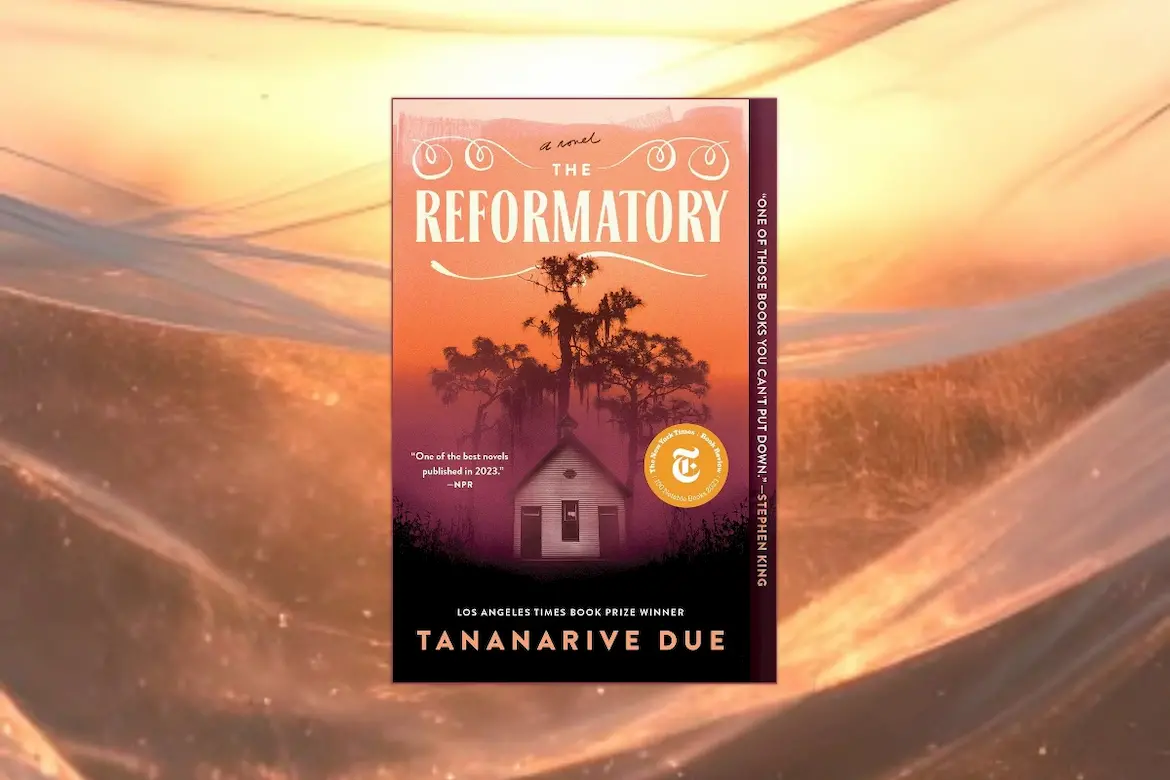
Here is LitStack’s review of The Reformatory, by Tananarive Due, daring readers to face chilling truths within a gripping narrative. Read on and explore this haunting tale that challenges perceptions and ignites discussions.
In This LitStack Review of The Reformatory

The Reformatory
by Tananarive Due

Dare You to Look In The Mirror
The Reformatory by Tananarive Due doesn’t leave you at the window looking in; the window is a mirror. As you follow the characters’ perilous calculations—where a glance, a word, or a rumor can mean survival or doom—you are invited to map your own position within structures that harm. Where do you benefit from the language of safety? When do you remain quiet? What histories haunt your classroom, workplace, or book club? The Reformatory asks for more than empathy; it asks for orientation, accountability, and imagination.
The Haunted Institution
Tananarive Due’s horror novel is set in 1950s Jim Crow Florida. The story follows twelve-year-old Robert Stephens Jr., unjustly sent to the cruel Gracetown School for Boys for the “crime” of kicking a white boy—a pretext for deeper, generational malice. At the school, Robert discovers a terrifying gift: he can see “haints,” the ghosts of boys murdered by the institution’s staff. To survive, Robert must navigate the brutality of the living and the demands of the restless dead, aided by his sister Gloria, whose gift of foresight and grit serve as his crucial link to the outside world.
The Machinery of Physical Terror
The Reformatory is one of the most important novels of this young century—a diagnostic tool that cuts into the horrors embedded in our daily routines of privilege. Due uses the horror genre to make visible the ongoing machinery of systemic racism. In Gracetown, the monsters are institutional. No single guard bears sole responsibility, though some are much much worse than others; rather, the villain is the file, the form, and the meeting where “procedure” becomes a weapon. The system allows it.
However, Due’s horror is not abstract or bureaucratic. She anchors the “procedure” in the visceral reality of extreme, unflinching violence. Believe me, several scenes shook me to the core. The “Funhouse”—the school’s site of corporal punishment—is not a metaphor; it is a factory of pain. And it is not the worst of it. By depicting the physical brutalization of these children with a clinical, harrowing realism, Due ensures the reader understands that when discipline is automated, the result is broken bodies and blood on the floor. When harm happens with “clean hands” at the administrative level, it is always felt with agonizing weight at the physical level.
The Weight of Inherited Trauma
Harm doesn’t begin with a single incident. Instead, generational trauma preloads the body with alarms. The novel uses hauntings as a metaphor for trauma that lives in muscle memory and breath. These apparitions—the “haints” who bear the physical marks of their violent ends—insist on bearing witness, refusing the reader the comfort of selective amnesia.
When you grow up inside systems where punishment is routine and visceral, fear becomes anticipatory. The Reformatory captures the rational, yet tragic, strategies of the oppressed: choosing silence over truth, shrinking one’s profile, and avoiding joy that might draw unwanted attention. A father’s caution becomes a son’s constraint, even decades later.
The Horror of the Silent Participant
In The Reformatory, complicity shows up as paperwork filed on time and eyes lowered at the right moment, and eager participants in “justice.” Due’s craft invites ethical spectatorship. As readers, we are placed in rooms where someone could speak up—but doesn’t—and we feel the suffocating dread that silence breeds.
It is a double dread. Because we are merely readers, we have no voice; we cannot speak up to change the outcome. This is the real horror the book exposes, and it is an insult to everything you may have thought before, but take a breath and ask yourself, “Have you spoken up?” We must admit that, in the world of the book, of being a reader who can only hear, we have not spoken up. Due acknowledges the fatigue and fear that make convenience win over courage.
The Power and Cost of Resistance
Resistance here is never abstract; it is measured in lost sleep, bruised bodies, the number of “haints” killed in a week, and the invisible ledger of who gets targeted next. Due depicts the extreme cost of defiance—smuggling a warning or refusing to corroborate a lie—as something that can mark a person for immediate, violent retribution, such as uttering the word “escape.” The novel’s power lies in showing that courage isn’t a cinematic crescendo, but a series of incremental, dangerous choices made in the shadow of a system designed to exhaust and break the human spirit.
What We Do Next Matters
Through a Black horror framework that makes institutions the monster and memory the witness, Due turns the reader into a participant. The novel’s haunted corridors are mirrors demanding we recognize how policy and habit and complacency can be instruments of racism and harm.
As most masterpieces of fiction will be able to achieve, as the last page closes, the question is no longer what happened inside the reformatory, but what happens outside these pages. This book lingers. It changes you. How do we teach, review, organize, and vote? How do we protect the living and honor the dead? The chill it leaves is a call to wake up, to remember, to reimagine.
Will You Be Quiet? I dare you to read this book.
~J.S. Hood
About Tananarive Due

Tananarive Due is a preeminent voice in black modern literature, an American Book Award winner whose career spans over two decades of pioneering work in Black speculative fiction and horror. Often described as a scholar of the “Sunken Place,” she shares her expertise as a lecturer at UCLA, where she teaches influential courses on Afrofuturism and Black Horror. Due’s literary journey began as a journalist for the Miami Herald, an experience that sharpened the empathetic, research-driven prose now characteristic of her novels. Her debut supernatural thriller, The Between, established her unique ability to blend the mundane with the macabre, a theme she expanded upon in the acclaimed African Immortals series.
A central tenet of her work is the belief that “Black history is Black horror.” This philosophy is most strikingly realized in her 2023 masterpiece, The Reformatory, which won the Bram Stoker and World Fantasy Awards. The novel draws on the tragic real-life history of her great-uncle at Florida’s Dozier School for Boys, using the lens of historical horror to address systemic trauma and racial injustice.
Beyond the page, Due has significantly shaped the genre’s visual landscape as an executive producer of the documentary Horror Noire: A History of Black Horror and as a screenwriter for Jordan Peele’s The Twilight Zone. Her writing does more than thrill; it serves as a “salve against the wounds of racist lies,” reclaiming narratives and ensuring that Black characters move from the periphery of horror to its powerful center.
Other LitStack Recs
We’ve got other LitStack Recs for you, including My Sister the Serial Killer by Oyinkan Braithwaite, Thunderland by Brandon Massey, and You Should Have Been Nicer to my Mom by Vincent Tirado.
Other LitStack Resources
LitStack Spotlights
Be sure and check out LitStack Spotlights that shine a light on books we think you should read. We feature two books each week in our LitStack Spotlight, and offer suggestions for similar titles in our LitStack Spots.
LitStack Reviews
Also look at our LitStack Reviews, including reviews by Lewis Buzbee, Lauren Alwan, Allie Coker, Rylie Fong, and Sharon Browning.
LitStack Recs
Each week we offer a LitStack Rec, sometimes two books at once, sometimes more. Be sure and look at our LitStack Recs where you’ll find what you should read next.
You can find and buy the books we recommend at the LitStack Bookshop on our list of LitStack Recs.


As a Bookshop, Malaprop’s, BAM, Barnes & Noble, Audiobooks.com, Amazon, and Envato affiliate, LitStack may earn a commission at no cost to you when you purchase products through our affiliate links.