
For science fiction that goes beyond laser battles and warp drives, Arkady Martine’s Teixcalaan Duology—A Memory Called Empire and A Desolation Called Peace—offers an intelligent, emotionally resonant journey through the politics of empire, the fluidity of identity, and the intricacies of human connection.
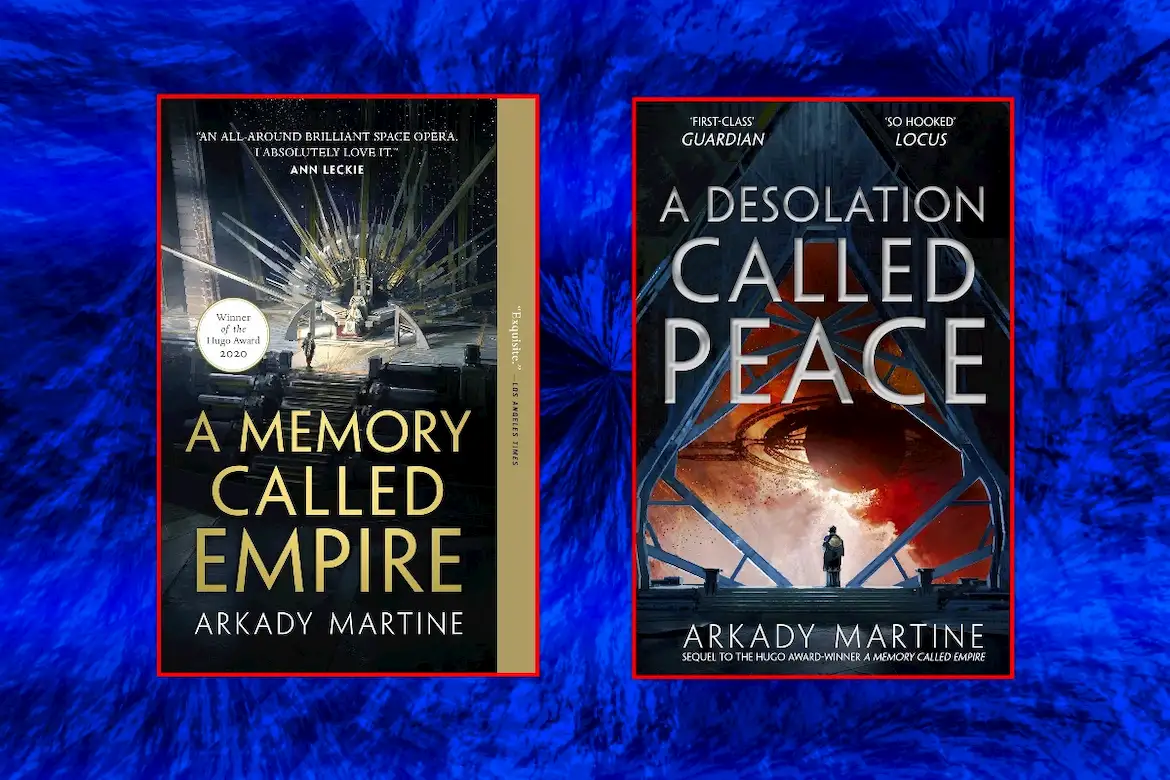
The novels of The Teixcalaan Duology are not just compelling stories; they are engaging, intelligent political thrillers, with stories elegantly told, that challenge readers to think about what it means to belong, to remember, and to communicate.
The Teixcalaan Duology gets all the love in this LitStack Rec.
You can find and buy the books we recommend at Bookshop on our LitStack Recs.

In This LitStack Rec of The Teixcalaan Duology
Book 1 of The Teixcalaan Duology
A Memory Called Empire
Diplomacy, Death, and Dual Consciousness
The first novel of the Teixcalaan Duology introduces us to Mahit Dzmare, an ambassador from the independent Lsel Station, sent to the heart of the sprawling Teixcalaanli Empire. Her mission is complicated from the start: her predecessor, Yskandr Aghavn, has died under suspicious circumstances, and Mahit must navigate a labyrinthine court culture while concealing a malfunctioning imago—a neural implant containing Yskandr’s memories and personality.
Mahit is not only solving a murder and preventing political annexation, but also wrestling with the voice of another consciousness inside her head, or in this particularly harrowing situation, the lack of experience that second consciousness provides. The novel’s brilliance lies in its subtlety—there are no grand space battles (in this one), only the quiet warfare of diplomacy, cultural assimilation, and linguistic nuance. With the help of her sharp-witted liaison, Three Seagrass, Mahit must decode the empire’s poetic language and survive its deadly elegance.
This book wears its science fiction well. As sharp as a LeCarre political thriller, this science fiction novel is near perfection for the genre. Even in a science fiction world of the Teixcalaanli Empire where the temptation would be to write large, space opera battles and set pieces, but Martine finds fear and danger in smaller, more subtle ways, though there is a bombing early in the novel. The danger here would be that this novel would be too slick, but Martine delivers human characters. Witty and acerbic dialogue make the scenes between Mahit and Three Seagrass pop, and Martine builds a realistically tender relationship that forms the backbone that carries this duology.
There is no doubt this novel came out in 2020, as Mahit faces a singularly lonely trap in the largest empire where she knows nobody, while her imago, her second identity, Yskandr, has been quieted by sabotage. She faces it alone, surrounded by a huge world, with the help of only Three Seagrass.

Book 2 of The Teixcalaan Duology
A Desolation Called Peace
War, Alien Minds, and the Limits of Understanding
The second book in the Teixcalaan Duology, expands the narrative from the imperial capital to the galactic frontier, where the Teixcalaanli fleet faces an existential threat that was hinted at in the first novel. A hive-mind species known only as the “Starfish” has been disappearing entire fleets. Mahit and Three Seagrass reunite on a diplomatic mission to broker peace with the aliens, while Fleet Commander Nine Hibiscus leads a military response.
Here, Martine shifts from political intrigue to a meditation on communication itself. How do you negotiate with a species whose consciousness defies human logic? Mahit’s linguistic expertise and fractured identity become vital tools in bridging this gap and communicating with the aliens. Meanwhile, Three Seagrass is forced to reconcile her loyalty to Teixcalaan with the brutal realities of its imperial ambitions.
Here again, the political thriller aspect of the novel makes this a fast, sharp, and exciting read. Shifting points of view keep the reading suspenseful, the scenes have witty, and hard-hitting dialogue, sharp and crisp, and character-revealing, and the story seemed to be very real, true to life, and yet set in a universe of sheer magnitude and scope that it could only exist in our imaginations and a novel. As hoped for in the second book in the Teixcalaan Duology, the relationship between Mahit and Three Seagrass deepens and grows into much more than a professional relationship, as they find themselves first in a fight, and then fighting to be with each other.
The Fluid Self: Memory, Identity, and the Imago
One of the Teixcalaan Duology’s most profound aspects is its questioning of the nature of identity. Through the imago technology, Martine explores how memory shapes selfhood—and how the past can both empower and destabilize the present. Mahit’s internal struggle with Yskandr’s voice is not a simple case of possession; it’s a layered negotiation between two selves, each vying for control, understanding, and autonomy. But there is more than that in store, as there may be more than one Yskandr imago.
This aspect of questioning identity, deepens in the second book, where the character Three Seagrass questions her role within the empire. Identity, Martine suggests, is not fixed—it is a dynamic, evolving construct shaped by culture, memory, and relationship.
Connection in Chaos: Love, Loyalty, and Emotional Resonance
Amidst the political machinations and alien threats, Martine crafts a deeply human relationship between Mahit and Three Seagrass. What begins as a cautious alliance grows into a bond marked by vulnerability, intellectual sparring, and emotional depth. Their evolving intimacy is portrayed with nuance and restraint, offering a counterpoint to the cold machinery of empire.
This relationship is not romantic in a conventional sense—it’s a study in mutual recognition, in the ways two people can see and support each other across cultural divides and personal trauma. It’s one of the duology’s emotional anchors, grounding the narrative in genuine connection.
Empire as Character: The Seduction and Violence of Teixcalaan
The Teixcalaanli Empire is more than a setting—it’s a character in its own right. It’s listening, and it’s watching. Martine renders the world of the Teixcalaan Duology with exquisite detail: a society obsessed with poetry and linguistic precision, and its own cultural superiority. Through Mahit’s outsider perspective (she’s thought of as barbarian), we see both the allure and the insidiousness of this privilege and dominance.
The pressure to assimilate—to think, speak, and behave like a Teixcalaanli—is a subtle form of violence. Martine deftly explores the tension between preserving one’s heritage and surviving within a hegemonic system. The alien “Starfish” in the second book complicates this further, presenting a consciousness so radically different that it forces a reevaluation of what communication and coexistence even mean.
Martine’s Prose: Lyrical, Intelligent, and Layered
Arkady Martine’s writing is a gift to readers who appreciate a fast paced, thoughtful, intelligent, and forward-moving narrative. Her prose is precise, rich and often poetic, reflecting the internal worlds of the characters. Her dialogue brims with wit and deliciously ambiguous subtext and the integration of Teixcalaanli poetry, adding texture and authenticity.
But Martine’s true strength lies in her ability to weave complex ideas—political theory, philosophy of mind, postcolonial critique—into a narrative that remains emotionally compelling and accessible. Her work rewards careful reading and invites reflection.
Why You Should Read the Teixcalaan Duology
If you’re looking for science fiction that challenges your intellect and stirs your emotions, The Teixcalaan Duology is for you. It offers complex, believable characters, a richly imagined world, thought-provoking scenes, genuine, evolving relationships, and beautiful, intelligent prose.
Ready to Dive In?
Whether you’re a linguist, a political theorist, or simply a lover of well written science fiction political thrillers, A Memory Called Empire and A Desolation Called Peace will captivate and challenge you. Add The Teixcalaan Duology to your reading list—you won’t regret it.
~ J.S. Hood
About Arkady Martine, Author of The Teixcalaan Duology

Arkady Martine is a speculative fiction writer and, as Dr. AnnaLinden Weller, a historian of the Byzantine Empire and a city planner. Under both names she writes about border politics, rhetoric, propaganda, and the edges of the world. Her debut novel, A Memory Called Empire, won the 2020 Hugo Award for Best Novel, and its sequel, A Desolation Called Peace, won the 2022 Hugo Award in the same category. Arkady grew up in New York City, and after some time in Turkey, Canada, Sweden, and Baltimore, lives in New Mexico with her wife, the author Vivian Shaw.
You can connect with Arkady Martine on their website and on Instagram and LinkedIn.
Publisher: Tor Books
ISBN: Book 1 Softcover 9781250186447
ISBN Book 2 Softcover 978-1250186478
Other Titles LitStack Likes
Other LitStack Resources
Be sure and look at our other LitStack Recs for our recommendations on books you should read. Also look at our LitStack Reviews, including reviews by Lewis Buzbee, Lauren Alwan, Allie Coker, Rylie Fong, and Sharon Browning.
As a Bookshop, Malaprop’s, BAM, Barnes & Noble, Audiobooks.com, Amazon, and Envato affiliate, LitStack may earn a commission at no cost to you when you purchase products through our affiliate links.