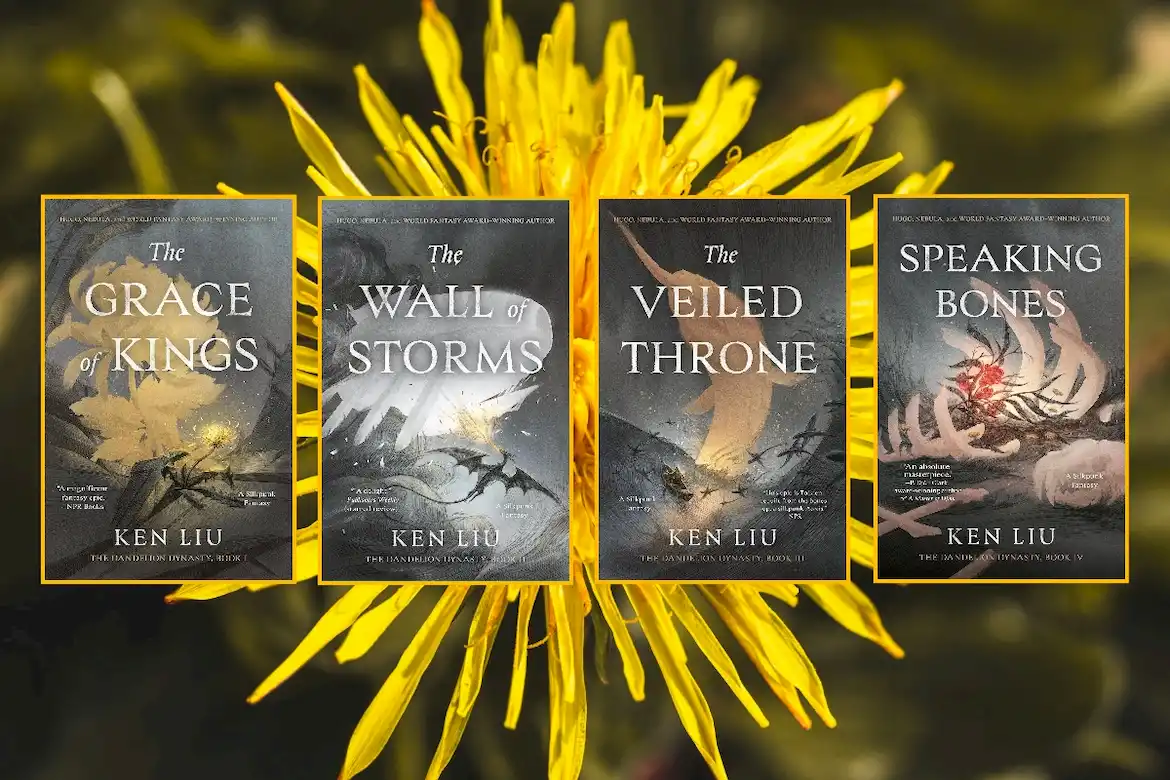
The Dandelion Dynasty by Ken Liu | Few books of contemporary speculative fiction match the historic grandeur and multi-generational scope of these books.
As an affiliate of Bookshop.org, Malaprop’s, Books-A-Million, Audiobooks.com, Chirp, 2nd & Charles, Amazon, NameHero, Envato, and Place-It, LitStack may earn a commission—at no cost to you—when you purchase through our affiliate links. We appreciate the brands we work with, and also appreciate that using our affiliate links may help you find your next great read, a book or two or more, in whatever form, while simultaneously supporting LitStack. When you use our affiliate links, you help keep LitStack running—and for that, we thank you.
You can find and buy the books we recommend at the LitStack Bookshop on our list of LitStack Recs.
In This LitStack Review of The Dandelion Dynasty
The Dandelion Dynasty
The Grace of Kings
The Wall of Storms
The Veiled Throne
Speaking Bones
by Ken Liu
Beyond the Myth of the Prophesied Hero
I finally finished reading the 3,616 pages of The Dandelion Dynasty and I’m fairly certain that few books of contemporary speculative fiction match the historic grandeur and multi-generational scope of these books. Ken Liu’s The Dandelion Dynasty is four volumes, The Grace of Kings, The Wall of Storms, The Veiled Throne, and Speaking Bones. To say this tetralogy is anything less than a monumental achievement in fantasy would be a misguided understatement, if not an outright faulty judgment. I left the tetralogy feeling as if I’d discovered a history of lands and civilizations that had somehow been erased from our knowledge, a piece of history somehow passed out of time that was brought back to life. These four books, and their painstaking, meticulous and fascinating detailing of two civilizations, its characters, its inventions and philosophies, seem to resurrect the story of something long-dead: the war-torn islands of Dara and Ukyu-Gondé. Rather than relying on familiar adventure and journey tropes of prophesied heroes and heroines brandishing magical rings and mystical swords, Liu has crafted a monumental story drawn from East Asian literature into a sweeping, generational chronicle of political revolution, technological evolution, the complex machinery of human statecraft, and the fragile weblike threads of human inspiration and connection.
An Empire Forged and Tested
The saga opens across the seven Islands of Dara, a multi-ethnic archipelago newly unified under the oppressive, iron-fisted rule of the Xana Empire. From the ashes of rebellion emerge two central figures whose improbable friendship and ultimate rift define the destiny of the realm. The Grace of Kings follows the rise of the revolution, where Mata Zyndu, a towering nobleman driven by a strict code of feudal honor, joins forces with Kuni Garu, an irrepressible former bandit who values pragmatic, meritocratic governance. Together, they bring down the emperor, yet their competing visions for the future spark a devastating civil war. Kuni ultimately prevails, ascending the throne as Emperor Ragin and founding the Dandelion Dynasty.
Decades later in The Wall of Storms, Emperor Kuni struggles to institutionalize his reforms while managing court intrigue. The fragile peace shatters when an existential threat breaches the impassable Wall of Storms: the Lyucu, a fierce, nomadic people riding giant, dragon-like predators called garinafins. Facing technological defeat, a new generation of leaders must innovate rapidly to survive.
The final two volumes, The Veiled Throne and Speaking Bones, form a closely tied climax. In occupied Dara, native citizens and Lyucu conquerors navigate a tense, fraught co-existence marked by espionage, cultural clash, propaganda, slavery and massacre. Simultaneously, an expedition travels across the sea to the Lyucu homeland. The crisis resolves not merely through military force, but through scientific breakthroughs, linguistic translation, and philosophical reconciliation.
The Main Operatives
At the core of this vast chronicle are characters who feel less like mythical archetypes and more like living figures in a historical text. To try and list all the characters would take more room than this review could handle. Kuni Garu, later Emperor Ragin, is a charismatic, highly adaptable leader who leverages intellect, empathy, and merit-based governance to unite Dara. His formidable rival and tragic foil, Mata Zyndu, is a warrior whose unwavering commitment to traditional honor and martial strength seals his ultimate downfall.
The story transitions smoothly to the next generation through figures like Princess Théra, Kuni’s visionary daughter and spiritual successor, who serves as a brilliant strategist and commander capable of bridging the physical and cultural divide between Dara and the Lyucu. She is supported by Zomi Kuti, a brilliant peasant woman trained in natural philosophy whose scientific rigor fuels the critical technological leaps needed to combat the invasion, and Gin Mazoti, a street orphan elevated by Kuni to Supreme General, whose unorthodox tactical genius turns the tide of catastrophic battles.
Fara Garu, the youngest child of Kuni Garu, becomes the unlikely person who brings about the transition from conquest and dynastic bloodshed toward reconciliation, governance, and genuine cultural synthesis. Fara grows up removed from the trappings of the battlefield, cultivating her artistic soul and an empathetic worldview. She adopts the pseudonym Dandelion to fit a persona that grounds her among the common people and outcasts rather than the insular court. She is reluctant to be of the ruling family because of her acute awareness of the horrors wrought by imperial ambition, and the horrors propounded by her Aunt Mother, the ruling regent Jia Matiza (more about Jia later below). Yet, when the bloodless revolution against Jia’s increasing autocracy deposes the old regime without firing a shot, Fara is thrust into power as the only figure capable of bridging the fractured world. Ascending reluctantly as Empress Shizona, she accepts the heavy crown not out of a desire for authority, but out of a moral duty to end the seemingly unendable cycle of violence. By forging a difficult, transformative peace with the Lyucu, aided by her deep connection to the Lyucu scholar Kinri, Fara brings about the “Reign of Enduring Spring,” and the ultimate victory of the Dandelion Dynasty is achieved not through martial conquest, but through empathy, intellectual synthesis, and the quiet courage to govern with a soft hand.
A Distinct, Silkpunk, World
To ground his world, Liu coined the subgenre term Silkpunk. While Steampunk relies on Victorian-era industrial aesthetics like brass, copper, and steam engines, Silkpunk draws inspiration from classical East Asian antiquity. Its mechanics are built from bamboo, silk, paper, tendons, bones, feathers, ox-hide, and wind or water power, creating technology rooted in natural philosophy and artisan craftsmanship.
This Silkpunk aesthetic produces memorable technological marvels throughout the series. Battle airships, or zheng, utilize flexible bamboo frames, stretched silk lift envelopes, and pulley-and-oar propulsion systems to transform military reconnaissance and warfare from traditional siege tactics into aerial combat. Navies construct submersibles (patterned after Crubens, a sea-turtle-like beast that they also ride) using treated leather, oiled ox-hide, and sinew-driven propellers powered by foot-cranks, enabling stealth naval operations. Even the sous-chef is reimagined through abacus logic engines, which use interconnected networks of mechanical rods, gears, beads, and woven silk threads as analog binary computers that cut and slice and even serve food, and which are, eventually, put to use in weapons to calculate trajectory, logistics, and engineering metrics.
One of the most memorable and satisfying Silkpunk inventions appears in The Battle of the Boneyards in the fourth book, Speaking Bones. Thera’s rebels have constructed the Arucuro Tocua Beasts, hulking, formidably tall creature ships built from the bones of ancient garinafins equipped with defenses against fire. They also carry a powerful secret sonic weapon, the Devine Voice. As wind and steam charge through bone resonance chambers, a screeching, high-frequency whistle rips the air, sending garinafins and soldiers into confusion and wild panics, incapacitating the garinafins and their riders with inner-ear agony.
The Silkpunk aspects of this novel are ingenious, and the detail given to them not only during the battles, but also in the flashbacks showing the history and inspiration for the inventions, gives them veracity. These “machines” could exist, and possibly should (in our world).
The Rhythm of Time and Connections
One of Liu’s most effective accomplishments is his dynamic manipulation of time in the narrative. At times, the tetralogy rapidly compresses decades into short, sweeping narrative summaries before suddenly zooming in to spend pages on a single philosophical debate or the inspiration and rise of an engineering breakthrough. Characters age, pass down legacies, and die. Historical movements outlive any single human lifetime.
This temporal rhythm is especially striking in how Liu handles the high-stakes military battles, as well as The Veiled Throne’s battle of The Best Restaurant in Ginpen Competition, where a battle between two restaurants, The Treasure Chest and The Splendid Urn, serves as an extended allegory of the two civilizations’ struggles. Rather than offering straightforward, uninterrupted action, Liu frequently pauses mid-battle, or mid-competition, to insert a full chapter that jumps back in time. These chapters step away from the immediate chaos of combat to trace the origin of a specific weapon or tactic or invention, exploring a character’s earlier inspiration, natural curiosity, or painstaking workshop trial-and-error. By interrupting the pulse of forward action, either battle or competition, with the quiet, contemplative labor of invention, Liu reinforces that triumph is rarely the product of sudden valor. Instead, victory is the culmination of past intellectual sparks, scientific curiosity, long-term preparation, and innumerable strings of failures and successes.
The connective tissue between inspiration, creation, toiling and outcome are brought to the forefront, and this heightens each battle’s suspense, bringing a sense of participation, a “you are there” feeling, to the reader’s experience. We experience history, not merely a battle.
More importantly, these temporal shifts show interconnected cause and effect across the four volumes. An airship lift-gas mechanism introduced during the early rebellion in the first book undergoes decades of refinement, eventually serving as the foundational engineering used to build dreadnought fleets and gliding suits of the final installment. The moral debate between rigid idealism and outcome-based flexibility introduced in the second book becomes the exact framework Princess Fara uses to negotiate a lasting peace. The study of Lyucu poetry, grammar, and syntax introduced during the occupation in the third book provides the precise translation key needed to draft a final treaty.
A Ship in a Bottle
Constructing a four-book fantasy series of this scale can be compared to the often-used literature metaphor of building a ship in a bottle. You cannot place a fully formed vessel inside the bottle; you must construct every mast, boom, and sail outside, fold them flat, slip them through the narrow neck, and pull them upright using thread and fine tools.
As a reader, the initial experience of this technique is one of quiet, painstaking yet intriguing assemblage. These are books you take your time to read. Liu methodically builds his history by feeding thousands of seemingly disparate details through the narrow neck of his narrative (into the confined space of Dara and Ukyu-Gondé): a specific knot used in silk rigging, a dialectical quirk from a remote island, a local culinary tradition, a dry legal footnote, a chance utterance that inspires a technological breakthrough. For hundreds of pages across multiple volumes, these elements lay flat within the story, appearing as necessary details of localized world-building or minor historical color.
The true revelation of connection occurs in the final volume, when Liu pulls the master thread. The long narrative lines, historical precedents, technological iterations and character connections arise in tandem, revealing a fully realized and monumental history of a civilization inside the glass. The experience is one of spiritual, breathtaking illumination, as the prose reveals a structure holding up an entire society.
The story itself operates as part of this metaphor. In The Dandelion Dynasty, history is not a chaotic sequence of random accidents, nor is it governed by magical destiny. History is a constructed artifact. Just as an artisan carefully designs a model ship to fit a specific vessel, the characters within Dara, the engineers, linguists, philosophers, and statesmen, are constantly struggling to craft a durable, flexible state out of fragile materials like silk, bamboo, language, empathy, and law.
The narrative mirrors their struggle. By revealing how individual ideas, personal sacrifices, and mechanical innovations are folded into the foundation of the empire, Liu shows that civilization is an intricate, highly calibrated system designed by human hands, built within the hard boundaries of geography and time, and held together by the delicate threads of shared history and personal connection.
A Towering Heroine and Nemesis
And now, Jia Matiza. Towering at the center of this intricate history is the ruling regent, the Empress Jia Matiza, a character you hate and love, who embodies the ultimate duality of statecraft. She is simultaneously the savior of the empire and its darkest internal threat.
As the heroine, Jia, the pseudo-empress hiding behind the title of regent, is the strategist and guide behind the realm’s survival. During the early rebellion, her advice and counsel guide her husband Kuni from being a simple bandit leader to becoming emperor. When the Lyucu invade Dara, Jia’s deep knowledge of botany enables her to engineer biological countermeasures, decimating the food supply of the enemy’s beasts, and she eventually defeats the Lyucu by cultivating and modifying Tolyusa, a rare plant that holds deep ritualistic value for its mild hallucinogenic properties and is essential to the health and reproduction of the garinafin mounts. The population develops a chemical dependency that cripples the occupation.
As the nemesis, driven by a cold, authoritarian belief that stability requires absolute control, Jia becomes, despite a painful metamorphosis, a ruthless tyrant. Fearing that independent military heroes threaten long-term peace, she orchestrates the downfall of loyal generals, frames allies for treason, and rules behind a veiled throne through secrecy, propaganda, and fear. Jia is neither a simple villain nor a pure protagonist, but rather a tragic realist who willingly accepts the moral guilt of tyranny so that the state might survive.
She is the towering and foundational character upon whom Ken Liu built this tetralogy. At first, I hated Jia because of her selfish scheming and treachery. Then I loved her as the sacrifices and the costs of her duties as regent came into clarity. She is a classic “Mother” figure, the weight of the world is thrust on her shoulders, and she alone must bear not only the actions she has to take, but all the slings and arrows of aftermath, of guilt, misunderstanding, misinterpretation and hate. She is truly the character without which these novels would not stand up as they do. She is a magnificent rendering, and I would argue Jia Matiza is one of the towering women characters in modern literature.
Legacy of the Dandelion
Ultimately, The Dandelion Dynasty is an astounding accomplishment, and one of the best speculative fiction series I’ve read, equal parts compelling and profoundly grand. Yet what truly excited me and kept me glued to the pages was the sheer structural realism of the narrative. It reads less like a conventional fantasy novel and more like a meticulously researched work of history or narrative non-fiction with fantasy elements of Silkpunk included. I never felt coddled with easy, fast-paced exposition. Instead, reading the novels required patience, immersion, and intellectual rigor. I found this incredibly exciting and invigorating, as history has that effect on me. Navigating this vast world required careful, deliberate reading. I found myself constantly flipping to the front of the book to find places on the maps, cross-referencing the extensive glossary, and tracking character names and family trees through the 8-page character list. I even turned to an external resource, the comprehensive Dandelion Dynasty wiki to keep track of the political shifts, technological specs, past events and character relations. This all made the read even more exciting, and in a strange way gave the world of the novels even more of a historical veracity. It made this world, it events, and its inhabitants seem all the more real.
This tetralogy is not a casual skim, or quick read, it took me a few months to read all four books. But the patience and effort demanded by the text is precisely what made the reward so magnificent. Every minute spent studying a map or piecing together intergenerational rivalries paid itself in full as the grand scale of the world of Dara revealed itself. When the final pages arrived, I was left not just with the memory of a story told and battles fought. I was left with the unforgettable sensation of having lived through and experienced an entire era of human and historical connections, triumphs, tragedies, and transformations. I would gladly give up a few more months to read the tetralogy a second time. It’s massive in scope, massive in pages, and has a profound effect on the reader as it unfolds a genuine and vast vision of a time and place and people that, though fiction, seem resurrected from the graveyard of history.
Ken Liu is an American author, translator, and speaker celebrated for his contributions to speculative fiction. Before transitioning to writing full-time, he trained as both a software engineer and a corporate lawyer, analytical backgrounds that deeply inform the structural ingenuity of his storytelling.
Liu is widely acclaimed for his four-volume epic fantasy series, The Dandelion Dynasty, starting with The Grace of Kings. For this sprawling saga, he coined the subgenre “silkpunk,” a blend of East Asian classical antiquity, philosophical traditions, and engineering-driven technology where engineers and scholars take center stage instead of traditional wizards.
A multiple Hugo, Nebula, and World Fantasy Award winner, Liu made literary history when his poignant story The Paper Menagerie became the first work of fiction to win all three major genre awards simultaneously. Beyond his original novels and short fiction collections, he is a renowned translator credited with introducing major works of global science fiction to English-language readers.
Be sure and check out LitStack Spotlights that shine a light on books we think you should read. We feature two books each week in our LitStack Spotlight, and offer suggestions for similar titles in our LitStack Spots.
Each week we offer a LitStack Rec, sometimes two books at once, sometimes more. Be sure and look at our LitStack Recs where you’ll find what you should read next.
You can find and buy the books we recommend at the LitStack Bookshop on our list of LitStack Recs.
As an affiliate of Bookshop.org, Malaprop’s, Books-A-Million, Audiobooks.com, Chirp, 2nd & Charles, Amazon, NameHero, Envato, and Place-It, LitStack may earn a commission—at no cost to you—when you purchase through our affiliate links. We appreciate the brands we work with, and also appreciate that using our affiliate links may help you find your next great read, a book or two or more, in whatever form, while simultaneously supporting LitStack. When you use our affiliate links, you help keep LitStack running—and for that, we thank you.